Showing posts with label Canada. Show all posts

Wednesday, 26 June 2013

Heading Down to Texas - Day 10

After 9 wonderful days in Canada travelling across two great prairie provinces it was time to migrate south to continue the learning.  I have say a huge thank you to all of my hosts in Canada, fellow Nuffield Alumni and everybody else, it wouldn't have been possible without your help.  A special thanks though to Barb, John, Josh, Erin, Morgan and Lyndon for putting me up for my stay in  Saskatoon, (keep practising the Mario cart - you know who you are!).  It was an early start for the flight from Saskatoon to Denver and some of the farming scenes below where completely different to those of home.  These circles are all pivot irrigation booms, creating a 'pac-man' like view as far as the snow covered rocky mountains.  Stunning and vast!
I didn't have much time to take in the sights of Denver airport as it really was a sprint to catch the next plane down to Houston in Texas.  When I got there however can anyone spot what is missing from the picture below?
Yes that's correct, no planes!  There has been a delay to our flight (and others) so I have had a lay up at Houston for longer than I thought, 6 hours at the moment which has allowed to catch up on some e-mails from home, and finally get bag up to date on the blogging.  Well you have to take the positives out of these scenarios!

Day 9, Really Already? GIFS Today

Tuesday morning and I was back at the National Research Council building at the University, this time to meet the head of GIFS (Global Institute of Food Security) Dr Roger Beachy.  The organisation was only started in December 2012 and Roger has been tasked with setting up the organisation and then finding his replacement.  Roger, a former Chief Scientist to the U.S. Department of Agriculture; who was appointed by Barack Obama, has been in post since January this year.   Needless to say I was really privileged to get a meeting with him.  I was only supposed to stay for 30 mins but after an hour we had to stop the conversation.  GIFS has been set up with funding from Potash Corp,. of Saskatchewan Inc, ($35 million) along with $15 million from the Provincial Government of Saskatchewan over 7 years.  The idea is to bring three main streams of agriculture together to fund research and have an overall Ag strategy.  GIFS mandate is to 'Address the increasing global demand for safe, reliable food' The aims will be to help farmers cope with climate change at a time when farmers battle between improving productivity and maximising profit margins, while balancing long term sustainability.
Roger is adamant that times are changing, and food needs to be more nutritious which can be achieved with the help of the breeders.  Plant breeders, farmers, scientists and marketeers working together to develop, grow and then sell better food with less environmental impact has to be the way forward and it's great to have that vision.  It won't be easy to achieve but I have a feeling a lot of good will come from GIFS and I look forward with excitement to see what will be next.  It's just a shame that our government is unable to make those connections and link up the food chain.. Who knows if we produce better engineered, nutritious, food people will pay more for it, reducing our reliance on the CAP reform?
I drove down to Davison after meeting Garth Patterson for lunch, its about 100km south of Saskatoon to meet up with prominent farmer Gerrid Gust.  Gerrid and his family farm about 16,000 acres of wheat, canola, peas, and lentils.  The farm also owns it's own elevator, which they use as a grain store.  The elevator can hold up to 120,000 bushels of wheat and it was great fun to hoist myself up the man lift to the top to see the view of the farm and the surrounding area.  Gerrid's family have been farming here since the first settlements in around 1908.  I have been amazed at the strength and perseverance of the original settlers.  I can't image what they would have been letting themselves in for, arriving after a week and host, then a week on the train, before walking out to find their section of the prairie.  This land was free to settlers but they had to break 10 acres and build a house in the first 3 years.  It must have been hard!
Gerrid grows these crops with about 15" of rain fall which is quite dry although this year the weather has really been helping the crops with lots of rainfall, although temperature have been cool.  Gerrid's crop's grow to maturity and harvest in roughly 100 days, so when its go, it's go!  Here's the view from the top of his elevator looking down the train line with the Case dealership (centre top).  There is also a John Deere dealership across the road, as they always seem to travel in pairs!


Day 8 and It's Back to The Classroom at the UoS

Monday morning and I was back at school, not mine but the University of Saskatchewan, in Saskatoon.  I was here to meet Bruce Coulman and Kofi Agblor at the Crop Development Centre (CDC).  We spent the morning talking about breeding techniques and history of the CDC.  Since it started in 1971 over 400 varieties have been developed and bred here and then passed on to local companies to breed on and sell to the farmers.  The focus is on breeding and genetics.  The main breeding program is looking at yields, fusarium head-blight, earliness of maturity and resistance to Wheat Midge, the same pests we call  Orange Wheat Blossom Midge.  40% of the funding comes through the government and the rest from producer groups and industry.
One of the really great assets at UoS is the Phytotron which is basically a growth chamber where light, humidity and temperature can be controlled.  This means that faster turn around of crops can speed up the breeding cycle, and considering the spring wheat's have about 100 days to mature this could potentially enable three generations to be bred in one year.  There are about 180 in total at the University and $12 million has recently been raised to refurbish them.
Part of the team is looking at the quality of the wheat and how it reacts through the backing process. The picture above is of an experiment looking at the stickiness of dough from a particular variety of wheat.  There's an interesting topic on reducing the salt levels in bread to make a healthier loaf.  The salt (sodium) reacts with the gluten affecting the baking characteristics. Current sodium levels are about 360mg per 100g loaf, which surprised me because you don't really taste it.  Imagine if we could engineer a bread that didn't need the extra added salt to the mix to create our loaves, a perfect solution to a healthier diet.
Later that morning we met up with Curtis Pozniak who heads up the breeding program.  Curtis currently has about 42,000 trial plots in his current research.  GPS technology is used on the seed planters to accurately locate all of those seed trials, and some of them might only be a foot squared.  There was also the Canadian seed bank at the University where seed goes into long term storage, where it can last between 50-70 years, when stored at -25 Celsius.  
I took a wander around the University grounds between meetings and I have to say the architecture is fantastic.  New development is happening everywhere to house and educate the 20,000 or so students here.  Of those 1,200 are being taught Agriculture.
After lunch I had a meeting with Faouzi Bekkaoui, the Executive Director of the Wheat Improvement Flagship Program at the NRC (National Research Council).  One of the big projects at the moment is the Canadian Wheat Alliance, who are targeting three main areas of investment into future wheat development.  They are looking at Accelerating Variety Development, Sustainable Yields - Cropping with Variable Climates and Increased Productivity and Sustainable Profitability.  One aspect I was very interested in was the Beneficial Biotic Interactions and using the Synchrotron light source (the only one in Canada) to try and learn more about the soil and how it functions.
Thanks to everyone who hosted me today, getting back in the classroom was actually rather enjoyable until I came to leave and found a parking ticket on the car!  Luckily the attendant was still there so I pleaded ignorance (not too hard) and was let off the $25 fine so thanks to the security guard as well who ever you are!  These Canadians eh, great eh?


Tuesday, 25 June 2013

Day 7 - A Day of Rest? Nope

Pancakes for breakfast with maple syrup which I have to say is a great way to start the day. After a catch up on the terrible flood at Calgary and Canmore (where we were on Monday) a neighbour of Ian's came over to say hello.  We chatted about crop marketing after the dissolution of the Canadian Wheat Marketing Board.  A move that was well over due and has freed the market up substantially.  Farmers are now able to grow what the customer desires.  Jeff is growing milling wheat specifically for the local mill, can organise the price, transport and when he wants to sell it.  Previously the movement period was dictated by the CWB, and only 80% of the expected value was paid on delivery.  The balance paid at the end of the season.  Seems a crazy really, farmers were even put in prison for selling wheat across the border to the US.
Here's a new crop for me, lentils.  These has some ascochyter developing on the lower leaves due to the wet humid weather.  The crop should be flowering in about a week and will, like everything else grow very quickly.
The crop below is a crop of 'Roundup Ready' Canola.  There are three main types of herbicide resistant Canola used in Canada, Roundup Ready, Clearfield and Liberty.  Each of these varieties are resistant to their specific family of herbicides.  This makes great sense to me.  Take our crops; they could potentially receive 4 different herbicides, with 4 different application timings and here they do just one.  Think of the fuel savings; in the pocket, but also a saving for the environment, of application fuel and manufacturing petro-chemicals.  To me there seems no problem with 'Biotech' crops from an agronomy point of view.  There is resistance to watch out for but we have that to manage now anyway.  There are over 100 different varieties of biotech crop.  The first stage in planning is to work out which family you want to use (best practise is one different to last time, so the volunteers are susceptible in the next crop), then you can choose for different traits, drought, yield, cold hardiness, shedding resistance etc, just as we would for conventionally bred varieties.  Imagine if we could use these crops in the UK and have them resistant to fungi, rusts, slugs or insects, we could cut down or reduce the amount of chemicals we currently use.  Imagine that no insecticides! Why should we take the moral ground in the EU and allow imports of selected GM produce, and have farmers elsewhere in the world growing them.  If it's safe for them to grow then it's safe for us.
Back to this crop.  It was planted on the 15th May and after 39 days it was at stem extension with green bud showing.  The stand was very even and the field just went on for a far as the eye could see.
When I got back to Saskatoon after fixing a puncture on the way; and driving 50Km very slowly on my mini wheel, all part of the Nuffield experience, I headed out with my host John Cote to a large auction house. Ritchie Bros has fairly regular auctions all over the province.  It was an incredible sight with 38 combines, 33 large sprayers, 24 swathers, trucks, trailers, augers, backhoes, rollers, seeders and the list goes on.  It was a very impressive sight.  I made it back to the auction on Monday but unfortunately missed the main items being sold.
I quite fancied a bid on the little McCormick below, obviously there were no green ones there, and I guess the haulage home might be a little inhibitive, never mind there will always be another time and place.
 

Day 6 - Saturday 22nd June

Nozzles; probably not an interesting topic to some people but to Tom Wolf they are a science and an art form.  Getting the right spray droplets at the right pressure with the correct forward speed, all make for better applications of pesticide, which is sensible considering the environmental damage they can cause and the financial of pesticide being sprayed over the fields.  Tom gives advice to growers about application technology and through a Nuffield connection (thanks Steve), Tom very kindly agreed to meet Andy and myself at very short notice, and what an interesting and very informative time it was.  We looked at nozzle performance under different pressures creating different spray patterns.  We discussed technology, part of Andy's Nuffield topic, which was fascinating.  I learnt about Aim Command that allows you to control individual nozzle's which is terrific news.  Savings over and above auto sectional control are between 6-10%.  Then there was Capstan Ag pin point control system linked to turn compensation, meaning nozzle flow variation when turning on the headland.  It really was a great morning and very educational.
After lunch Andy headed out to the Saskatchewan/Manitoba border and I headed an hours drive West to meet up with Nuffield Scholar Ian McPhadden at a small town called Milden.  Ian's farm is now let out to neighbours but he still keeps a very close eye on the industry and works hard with lots of Ag groups, including being on Nuffield Canada's Interview panel for scholar selection. Ian was very welcoming and although I hadn't planned on staying a bed was soon made up and a toothbrush located. 

We headed into Milden for supper at the small hotel/pub.  Milden was built on the side of the railroad.  Small towns are every 6 miles, which was as far as the settlers could go, (there and back) with a horse and cart in a day.  Milden has a population of about 200 people and the hotel/pub is the main attraction.  The ribs were great and served in a buffet style.  After dinner we sat on the veranda, having a beer and I listened to tales from Scotty Bell, a regular at the pub, telling stories of  his childhood.  Scotty was quite a character!
After dinner we headed back to Ian's farmhouse before turning in for the night.  Here's Ian in the back of Jeff's truck the following morning going out to the fields to look at some crops.


Monday, 24 June 2013

Day 5 - The Road to Saskatoon

Andy and I headed East in the rain and drizzle from Three Hills, Alberta heading to Saskatoon in Saskatchewan.  The trip was just over 500 kilometres.  We stopped along the way a few times to take some pictures. One of the most outstanding memories of the trip so far was the amazing rich coloured, wide open, clear sky's, with clouds uniquely dotting the horizon.  It was truly beautiful.
For most of the road trip, our destination was straight in front of our noses with a few very important intersections marked for our attention.  Any bend was greeted with a cheer as we pushed on through the day.
Naturally we had to stop at some of the towns along the route, for gas for the car, or for us!  One place we stopped at was a town called Kindersley and inevitably there was an Agricultural dealership; and not just one.  There was be a John Deere dealership on one side of the road and a Case IH/New Holland on the other, all with vast numbers of tractors, sprayers and combines regimentally lined up on display.  The workshop space was incredible; great amphitheatres with technicians gladiatorially battling with their spanners (or laptops!)
By the time we arrived at Saskatoon we headed to the Western Grains Research Foundation for a meeting with Garth Patterson, the Executive Director of the not for profit organisation.  Amazingly we drove straight into Saskatoon and straight to Innovation Place for our meeting.  After meeting Garth and Gina Feist (Research Program Manager) for some quick introductions; we headed down to Boffins Club where we were joined by Garth's wife Carole-Anne.  We had supper and discussed a range of different aspects of food, farming, genetic modification, breeding and end user concerns.  Andy and I even got up to have our photograph taken with the band, Whiskey on a Sunday, fortunately we were not asked to perform for our supper!
After leaving Garth and Carole-Anne Andy and I headed south around the city to find Barb Stefanyshyn-Cote, the chair of Nuffield Canada who had very kindly offered to put us up during our stay in Saskatoon.

Saturday, 22 June 2013

Alberta Day 4 - Beyond Agronomy

Our second day out with Steve started with a visit to Al Jones, who's family has been farming in Alberta since 1903.  Al runs about 5,000 acres with his family.  A herd of 200 Herefords (Herfuds) cattle also run on the farm.  We looked at some of Al's crops after a tour of the workshop.  Steve and Al are trialling precision rape seeding with very low seed mortality compared to the usual air seeding.  The photograph above shows the young canola seedlings growing fantastic root structures very quickly.  Al doesn't practise CTF (controlled Traffic Framing) but has been zero till for a long time.  Again what stood out was the lovely soil, very well structured even after a lot of heavy rain.
Al is also trying a field of Faber Beans this year to see how the crop develops and to get a handle on its Agronomy.  The crop was just starting to flower and in need of a herbicide, but weather delays, due to rain are frustrating the operation. (Sound familiar?)  Beans would be a fairly new venture in the area to add further diversity into the rotation.
I put this picture in of a huge tractor, used for seeding to demonstrate the low ground pressure that they are using when travelling on the fields.  These tires would run at 7psi on the front and 8psi on the rears. It helps that the tractor is duelled up but the attention to traffic and soil protection is a credit.  Getting the soil wrongly managed can be a disaster especially on the soils around Alberta.  Here's what we saw when driving to Saskatoon the following day, not a customer of Steve's!
After an agronomists lunch we headed out to visit Spencer Hilton who has land spread over a 100Km  strip end to end.  I bet it's quite a sight at harvest moving men and machines along the highway.  Spencer had a great business, succession and planing are the key.  Weekly family management meetings and regular staff meetings all made for a very well run business.  The staff were empowered that if they weren't happy, for a safety reason, they could shut the operation down, the management would sort it out and they would move on.  With the removal of the Canadian Wheat Board new markets were developing and Spencer was taking full advantage.  They are contracted to grow malting barley for an American brewing company where the risk was shared between the two parties, in the form of an area value rather than a bushel value.
A huge thanks to Steve and Vanessa for putting us up and showing us around the Three Hills area of Alberta, it really was a terrific visit!

Thursday, 20 June 2013

Alberta Day 3 - Three Hills with Steve Larocque

Day 3 and we've been very well looked after by Nuffield Scholar Steve Larocque who runs his own company with wife Vanessa called Beyond Agronomy.  Steve lives and works around the town of Three Hills in Alberta.  The town has a population of 2,500 and somewhere 19 churches!  Most of the farms in the area are about 3,000-4,000 acres and have been zero tilled for about 20years.  The soil is loamy, almost sweet smelling and with the great advice Steve is offering to his clients, yields are moving on up.
I was very interested in the planting methods used for zero till so we headed to the local John Deere dealership Evergreen's at Drumheller.  In the yard was a Seed Hawk planter with a seed hopper for fertiliser and seed that could carry 20T.  Bearing in mind nearly all of the fertiliser for the crop is applied at seeding, these rigs were huge.  All pulled by over 500hp of tractor either on duals, triples or tracks, with widths of up to 66'.  Even transport widths were hovering around the 5m mark!  We also looked at the John Deere ConservaPac opener which placed the fertiliser and the seed almost down the same drill row, seeding tine behind fertiliser tine, reducing soil disturbance creating a very even drilling depth and capable of following uneven topography, with short leg length.  Drilling speeds of around 4.5mph are common, so relatively slow compared to our drilling speeds but reduced soil disturbance is key to the system.  
After some lunch we headed out to visit a Hutterite Community at Starlands.  The we were met by 'Farm Boss' Peter Stahl.  It was a very slick operation and Pete was keen to show us around the farm.  The investment was huge with 3 big drilling rigs each worth somewhere near $750,000.  Each of these systems is capable of planting 350 acres in a 24 hour period, and with 14,900 acres (of all crops to plant), seeding can be completed in 14 days.  The infrastructure was impressive too with grain store, hog yards, dairy, beef and chickens.  The community share everything between each other, so all 93 souls get a share of the wealth.  At the communal kitchens we met Pete's wife and daughter who were busy preparing the fresh chicken for super that evening.  It's a shame I couldn't take any pictures but the I will certainly remember Pete for his warm welcome, generosity and openness into the way they live.
We called in to look at some of Pete's crops and the picture above show wheat plants being planted between the rows of Canola stalks.  This is using the guidance on the tractors (RTK) to the fullest and means the new roots and follow the old crop root channels down without all the stubble stalks being ripped up.  It also acts as protection to some degree to the young shoots as they emerge.  Another great day; meeting interesting people, more tomorrow.

Wednesday, 19 June 2013

Alberta Day 2 18th June

Day 2 and we are out on farm.  Today we were visiting the team from Agritrend who are a group of independent crop coaches (agronomists) who all work under the Agritrend umbrella  The company was started by Rob Saik in 1997 and is now involved in many aspects of farm business from agromomy,  business development and precision farming (incl data management) to grain marketing and many other aspects.
After meeting Warren Bills and Matt Gosling  (and a footlong sub for lunch), we headed to the fields in Wheatland County.  There are 1 million acres in the county and 3% of that land would be classified as the best soil in the province of Alberta, with about 1/3 of that land on the farm we visited.
The spear Matt used very easily went down 18" of no-till soil before he pulled out it out to reveal the black organic soil that smelt incredible.  The soil had just been direct drilled for about 20 years and was in a great condition.  Then he put the probe back into the hole and took out the next 18" down which was a more bodied clay but also very free draining and very accessible to the plants roots.  The crops here only have a very short growth period, maybe only 150 days from the middle of April until the middle of September when the first frosts kill off the crops.  They go through the growth stages very quickly.  The stem extension stage can take as little as 10 days (GS30-GS40)  At home that can take over 35 days.  Only 2 fungicides are applied as the crop grows so fast and the majority of the fertiliser is applied in the soil at seeding.  There are no growth regulators which limits the amount of fertiliser farmers can apply, effectively pegging yield as the crops need to stand.
The drilling rig here is about 21m wide (66') and the seed trailer at the back has 5 compartments.  One for seed and the other 4 for different straights of fertiliser so each nutrient can be variably applied, to a recommendation based on soil sampling, yield prediction and previous history.  The rotation is all spring cropping with OSR (Canola) then wheat followed by barley which is whole cropped to feed to the cattle.
The cattle feed lot, where 10 years ago they would have finished 22-25,000 head of beef now they finish 11,000 head due to the economics of beef production in Canada.  There are fewer processors to sell to so a proportion of the beef is shipped to the US for sale.  The cattle will travel down to Nebraska, Utah and Washington from here.
A huge thanks to Warren, Matt and Rob for showing us around the operation and also to Marissa for the excellent home cooked ribs we had for supper.  After leaving Matt's house we headed north towards Three Hills for the next leg of our journey.

Sunday, 7 April 2013

Canadian Wheat and Maple Syrup

After the Grain Farmers of Ontario March classic I met up with Steve Twynstra who owns a very impressive cash cropping business near Ailsa Craig, situated about 25 minutes drive North West of London Ontario.  Steve's business revolves around soybeans, corn and wheat and is spread over quite a large area surrounding London.  
I met Steve at the conference before I hired a car and headed out to meet him at the farm.  The workshop and office where we met were immaculate as was every piece of machinery I could see.  The tractors were polished clean, all the machinery goes through a very thorough process in the workshop through the winter period.  Steve also had 3 lorry units that he uses to haul, grain and fertiliser at certain times of the year.  The size of the equipment was very impressive as well.  A cultivator, similar to a germinator, with tines and rollers with levelling bars was tucked away and was 50' wide (15.25m).
In the last couple of years Steve had put up some very impressive on farm round silo's to hold the crop grown on the farm.  Steve has been using variable rate technology since the mid 1990's and has done a lot of research work on using yield maps to create the variable rate plans.  
After a lovely dinner cooked by Mrs Twystra (Dianne), Steve and I headed out in the snow in the truck to a neighbours farm.  Here the group meet up once a month to have a general agricultural discussion.  The group started as a marketing group and over time it has morphed into more of a general discussion usually with external speakers in attendance.  This is where I met up with Peter Johnson again and so we talked wheat for the next couple of hours.  I also had a few slides about being a LEAF Demonstration farm so I showed those off as well.  
The farm hosting the event also produced maple syrup form the maple trees on the farm.  About 100 acres of trees are tapped each year to produce the sap.  The sap only rises at certain times and needs a specific temperature pattern to get it going.  A cold frosty night should be followed by a warmer day.  The sap is collected and reduced down using wood fires.  The final process uses gas heat so that more control of the temperature can be obtained.  The native Indian population in Canada thought the first settlers how to do this using hollowed out trees filled with sap and then dropping hot fire stones in to remove the water and concentrate the syrup.  The process in reduced by a value of 40.  i.e. 40L of sap is required to make 1L of Maple Syrup!
The darkness of the syrup depicts the different amount of flavour.  The darker the colour the more intense the taste.  Different flavours occur during different times of the season, depending on how the sap rises.  It was a fascinating end to another great day.  The next I was on the road, getting up at 3.30 for the 7 hour, 400 mile drive East and then North to Ottawa, Canada's capital city, to meet up with my wife Andrea and daughter Jorja.

Friday, 22 March 2013

Nuffield Contemporary Scholars Conference - Friday The Global Environment

Up bright and early on Friday morning we headed out to VineTech Canada to meet Wes Wiens.  Wes runs a great business producing vine stock for other vineyards to plant.  He has about 20 acres with over 1.7 million vine plants growing at at any one time. Usual vineyard planting will be about 1361/acre.  There were two main things I took away from our visit to Wes's farm, firstly the backbone of his business is made on producing quality vines.  These varieties are sourced from around the world, including Germany, France and the US.  He ships vines to the main wine producing areas in Canada namely, British Columbia, Nova Scotia, Quebec and Ontario.  The vines are puzzle cut and then grafted onto rootstock before being planted out in the nursery usually for a year.  Wes sells most of the vines having been grown on under his control so there is less chance of them failing in the first year, again more work but quality ensured.  The second memory was how Wes looked after the 45 foreign workers employed during the busiest time of year.  Birthdays are recognised; and as many of the workers are foreign (Mexico and Bulgaria mainly), they are also encouraged to learn to read and write.
After a short bus ride we headed off around the Vineland Research and Innovation Centre which is a not for profit institute. A substantial amount of money is raised through commercial research and government funding. One of the major research projects currently underway is to increase the winter hardiness of roses 'out west'.  Another project that has born fruit was developing a new apple with funding generated through the Ontario Apple Growers.  The centre has a trained panel of tasters to have the ability to try out and benchmark new flavours, which meets up a couple of times a week.
Here's Steve Wilkins from New Zealand at the Vineland Research Institute.
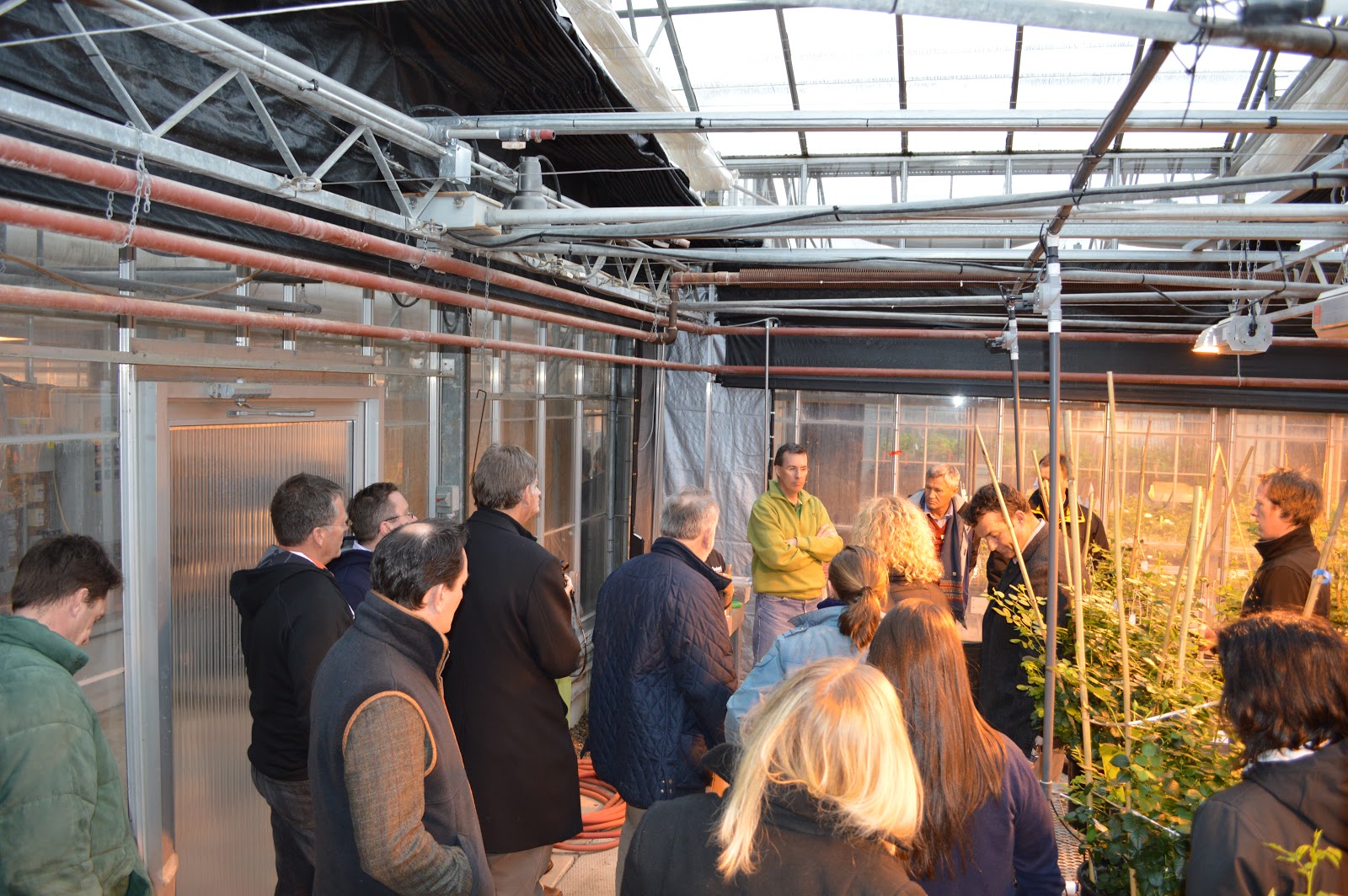
The roses in the breeding programme that we saw were in greenhouses being marked with different tags depending on their genetics and the characteristics that were being identified. It is hoped that a new rose might be commercially available in 2018, which is a long time to wait for a winter hardy rose bush.
After lunch we had a great talk by Andrew Novakovi on the United States Farm Bill.  The farm bill was put in place as a support mechanism for farmers many years ago and is amended every 5 to 7 years.  The first Farm Bill was started by President Roosevelt following the stock market crash of 1929, at a time of the dust bowls in the mid west.  It's role was to set out the the responsibility of the government.  The farm bill looks after, wheat, corn (maize), grain sorghum, barley, oats, upland cotton, rice, oilseeds, soybeans, sugar and peanuts.  The bill also spends money on nutrition, commodities and conservation.
Another aspect of the farm bill is for crop insurance where growers pay an area insurance policy.  This means that the income from the crop is secured so if your state goes into drought, then you are eligible to claim the value of insured crop.  This year between $20-$50 billion were paid out to US farmers due to the drought conditions! The US government knows that this level of subsidy payments can't continue but the farmers have a very strong voice when it comes to lobbying the politicians.  It will be interesting to see where the next negotiations go and how much money is available.
Jay Nutting was up after Andrew to talk about the role of the lobby in politics.  Jay is an Eisenhower Fellow a similar sort of scheme to Nuffield. Putting a point across is something we as industry need to do more of, no-one is going to do it for us.  Making local connections and being the 'go to' person who is straight forward and knowledgeable is what we, as Nuffield scholars need to do in our own communities and try to have influence over our own political masters.