Showing posts with label Ontario. Show all posts

Sunday, 7 April 2013

Canadian Wheat and Maple Syrup

After the Grain Farmers of Ontario March classic I met up with Steve Twynstra who owns a very impressive cash cropping business near Ailsa Craig, situated about 25 minutes drive North West of London Ontario.  Steve's business revolves around soybeans, corn and wheat and is spread over quite a large area surrounding London.  
I met Steve at the conference before I hired a car and headed out to meet him at the farm.  The workshop and office where we met were immaculate as was every piece of machinery I could see.  The tractors were polished clean, all the machinery goes through a very thorough process in the workshop through the winter period.  Steve also had 3 lorry units that he uses to haul, grain and fertiliser at certain times of the year.  The size of the equipment was very impressive as well.  A cultivator, similar to a germinator, with tines and rollers with levelling bars was tucked away and was 50' wide (15.25m).
In the last couple of years Steve had put up some very impressive on farm round silo's to hold the crop grown on the farm.  Steve has been using variable rate technology since the mid 1990's and has done a lot of research work on using yield maps to create the variable rate plans.  
After a lovely dinner cooked by Mrs Twystra (Dianne), Steve and I headed out in the snow in the truck to a neighbours farm.  Here the group meet up once a month to have a general agricultural discussion.  The group started as a marketing group and over time it has morphed into more of a general discussion usually with external speakers in attendance.  This is where I met up with Peter Johnson again and so we talked wheat for the next couple of hours.  I also had a few slides about being a LEAF Demonstration farm so I showed those off as well.  
The farm hosting the event also produced maple syrup form the maple trees on the farm.  About 100 acres of trees are tapped each year to produce the sap.  The sap only rises at certain times and needs a specific temperature pattern to get it going.  A cold frosty night should be followed by a warmer day.  The sap is collected and reduced down using wood fires.  The final process uses gas heat so that more control of the temperature can be obtained.  The native Indian population in Canada thought the first settlers how to do this using hollowed out trees filled with sap and then dropping hot fire stones in to remove the water and concentrate the syrup.  The process in reduced by a value of 40.  i.e. 40L of sap is required to make 1L of Maple Syrup!
The darkness of the syrup depicts the different amount of flavour.  The darker the colour the more intense the taste.  Different flavours occur during different times of the season, depending on how the sap rises.  It was a fascinating end to another great day.  The next I was on the road, getting up at 3.30 for the 7 hour, 400 mile drive East and then North to Ottawa, Canada's capital city, to meet up with my wife Andrea and daughter Jorja.

Thursday, 4 April 2013

Nuffield Contemporary Scholars Conference - The End of The Beginning


Sunday morning arrived all too quickly after a late night in the bar; continuing  the discussions after Steve Larocque's excellent presentation; dancing, talking and letting our hair down (those of us that have any).  We even got restricted in the bar to one drink per person per hour, but that didn't dampen anybodies spirits.  Over the week I have made some incredible friendships and had some very interesting conversations and discussions about farming, global threats, encouraging new entrants into agriculture, trying to strengthen the appeal of agriculture to our customers and how we can feed people more sustainably.  I have also learnt that other farmers around the whole world are having the same discussion that we are, we are not alone and that by talking about problems, solutions can be found.  Soberingly I also appreciate the small part we, the UK, have to play in the global production of food.  However our part is becoming clearer to me, we need to be more productive, more efficient, more environmentally aware and better linked to our customer, whether that is the supermarket selling our lamb or the flour miller grinding the wheat that we grow.  Just the right time for my study topic, 20T/ha in 20 Years time, Fact or Fiction?
I also have 78 new best friends.  You might think that is impossible after only a week, but I know that if I wanted to go and visit any of the #Nuffield13 scholars doors would be wide open in all four corners of the globe and that is something very special.  Of course that is mirrored here at Overbury.  The washing machine will be maintained regularly to make sure it's ready to be pressed into service.
It really was a great week and one that will stay with me forever.  I know that we all felt the same way, and it was hard to say good bye to everyone; assuming that, as a group, we will probably never be together again.  There will be reunions from time to time but I sadly doubt all of us will be together again.
For some it was on with the Global Focus Group Tour, something I plan to do in the future.  Blake Vince (above) from Ontario is part of that group who headed to Washington DC very early on Sunday morning to continue the 7 week world tour.  Next week (8th April) they are in the UK so we'll meet up again, which will be fantastic to hear their stories from California and Brazil, having seen some facebook pictures and comments.
For others it was heading back to Toronto airport and back to the UK, but for me; I headed North West with Karen Daynard (CDN), Julian Raine (NZ) and Karen Brosnan (IRE) back to Guelph.
We stopped along the way at Sue-Anne Staff's winery, you could say for 'one for the road' and then after dropping Julian and Karen along the way, Karen (CDN- next to me) headed to her parents house. Terry and Dot Daynard had very kindly offered to put me up for the night.
I have to say it was a great feeling to be in a proper home and not living out of a suitcase for a change.  Terry and Dot cooked a lovely meal (on the BBQ in the snow, proper Canadian's) and we were joined by Karen and her sister Kelly, who spoke earlier in the week on social media.  After a great nights sleep and Dot doing some washing for me (thank you so much), we had a look around the farm buildings and the outside corn store
which was used to store corn (maize) on the cob over winter.  The cold dry air would keep the crop safe gradually drying it out over the winter before it was sold.  Terry and Dot showed me some pictures of the store being filled.  In a dry year the cobs would flow easily up the elevator but if they were wet almost every one had to be prodded up into store. We also has a sneaky peak around the machinery shed and saw this little beauty..
tucked away.  I guess it was a sign, once entangled in the Nuffield world there is no escaping!

Friday, 22 March 2013

Nuffield Contemporary Scholars Conference - Friday The Global Environment

Up bright and early on Friday morning we headed out to VineTech Canada to meet Wes Wiens.  Wes runs a great business producing vine stock for other vineyards to plant.  He has about 20 acres with over 1.7 million vine plants growing at at any one time. Usual vineyard planting will be about 1361/acre.  There were two main things I took away from our visit to Wes's farm, firstly the backbone of his business is made on producing quality vines.  These varieties are sourced from around the world, including Germany, France and the US.  He ships vines to the main wine producing areas in Canada namely, British Columbia, Nova Scotia, Quebec and Ontario.  The vines are puzzle cut and then grafted onto rootstock before being planted out in the nursery usually for a year.  Wes sells most of the vines having been grown on under his control so there is less chance of them failing in the first year, again more work but quality ensured.  The second memory was how Wes looked after the 45 foreign workers employed during the busiest time of year.  Birthdays are recognised; and as many of the workers are foreign (Mexico and Bulgaria mainly), they are also encouraged to learn to read and write.
After a short bus ride we headed off around the Vineland Research and Innovation Centre which is a not for profit institute. A substantial amount of money is raised through commercial research and government funding. One of the major research projects currently underway is to increase the winter hardiness of roses 'out west'.  Another project that has born fruit was developing a new apple with funding generated through the Ontario Apple Growers.  The centre has a trained panel of tasters to have the ability to try out and benchmark new flavours, which meets up a couple of times a week.
Here's Steve Wilkins from New Zealand at the Vineland Research Institute.
The roses in the breeding programme that we saw were in greenhouses being marked with different tags depending on their genetics and the characteristics that were being identified. It is hoped that a new rose might be commercially available in 2018, which is a long time to wait for a winter hardy rose bush.
After lunch we had a great talk by Andrew Novakovi on the United States Farm Bill.  The farm bill was put in place as a support mechanism for farmers many years ago and is amended every 5 to 7 years.  The first Farm Bill was started by President Roosevelt following the stock market crash of 1929, at a time of the dust bowls in the mid west.  It's role was to set out the the responsibility of the government.  The farm bill looks after, wheat, corn (maize), grain sorghum, barley, oats, upland cotton, rice, oilseeds, soybeans, sugar and peanuts.  The bill also spends money on nutrition, commodities and conservation.
Another aspect of the farm bill is for crop insurance where growers pay an area insurance policy.  This means that the income from the crop is secured so if your state goes into drought, then you are eligible to claim the value of insured crop.  This year between $20-$50 billion were paid out to US farmers due to the drought conditions! The US government knows that this level of subsidy payments can't continue but the farmers have a very strong voice when it comes to lobbying the politicians.  It will be interesting to see where the next negotiations go and how much money is available.
Jay Nutting was up after Andrew to talk about the role of the lobby in politics.  Jay is an Eisenhower Fellow a similar sort of scheme to Nuffield. Putting a point across is something we as industry need to do more of, no-one is going to do it for us.  Making local connections and being the 'go to' person who is straight forward and knowledgeable is what we, as Nuffield scholars need to do in our own communities and try to have influence over our own political masters.

Tuesday, 19 March 2013

Nuffield Contemporary Scholars Conference - Thursday 'Evolving for and Urban Setting'

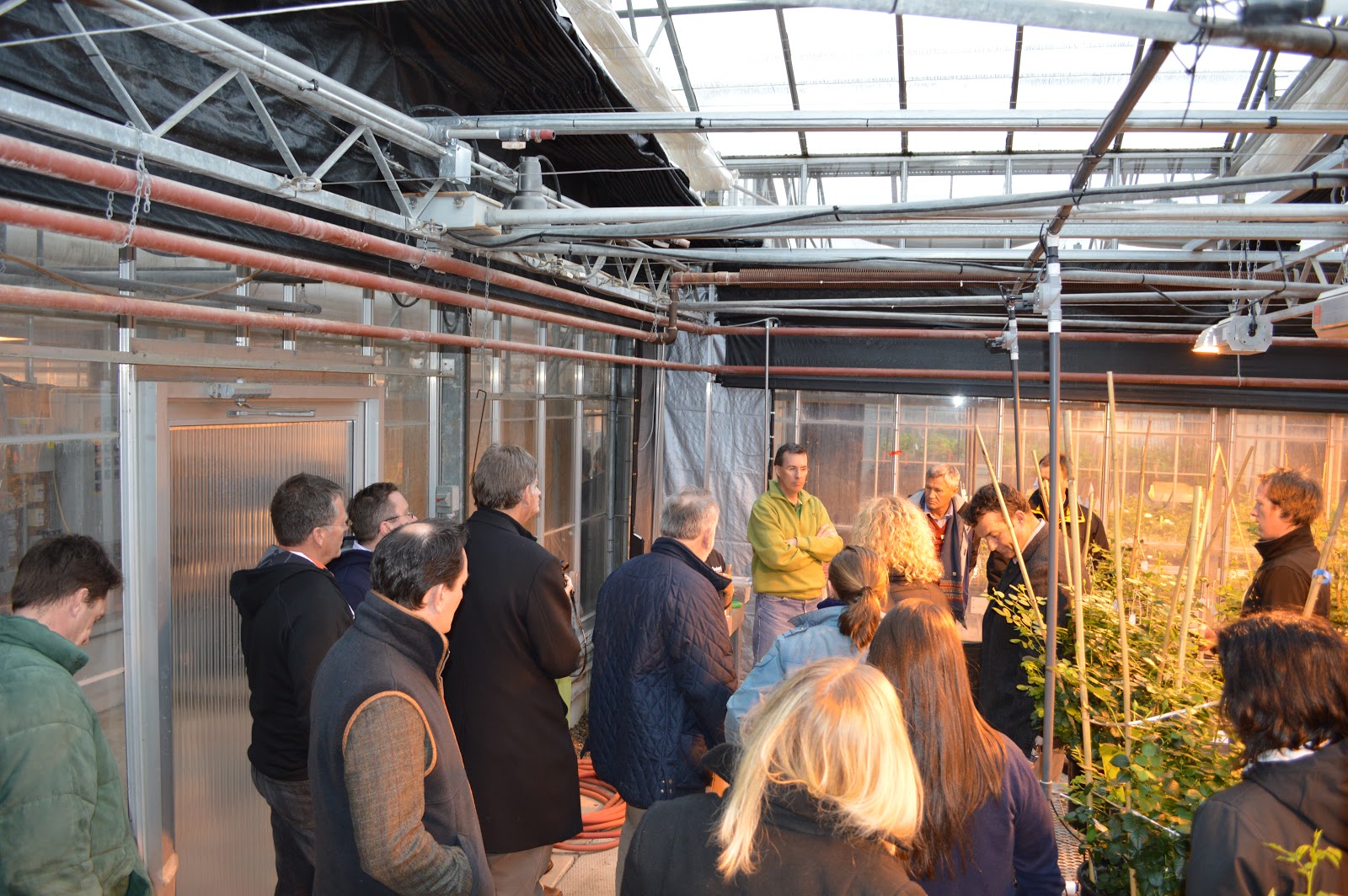
Thursday morning arrived way too soon.  Although the start was early everyone was up and ready to go.  We had to check out of the Guelph Delta hotel and board the bus by 8am.  Our first stop was Cranston Farms, a herd of 70 cows or so managed and owned by Doug and his wife.  The cows are housed all year round in a great light and airy barn. These buildings called 'Coverall's' a strong plastic type of material stretched over a aluminium or steel frame.  These were invented to withstand tornado's so that the fabric rips off in the wind.  A building this big can be re-roofed in a matter of hours!
The bedding was a unique mix of dry wall (I think the same sort of material as plasterboard) and dung. As the mixture builds up; being cultivated everyday, it composts down before being removed from the building.  The final 4' against the back wall is then spread out with a good supply of bacteria to start off the composting process again.  Housing cows all the time is a very contentious issue in the UK, but these cows were very happy and is standard practise here in Canada.  Everything the cows need is provided, including a vet, who happened to be on site, pregnancy testing the cows.  The ration was a complete TMR (total mixed ration) with maize, flax, soya and cotton, shown below.
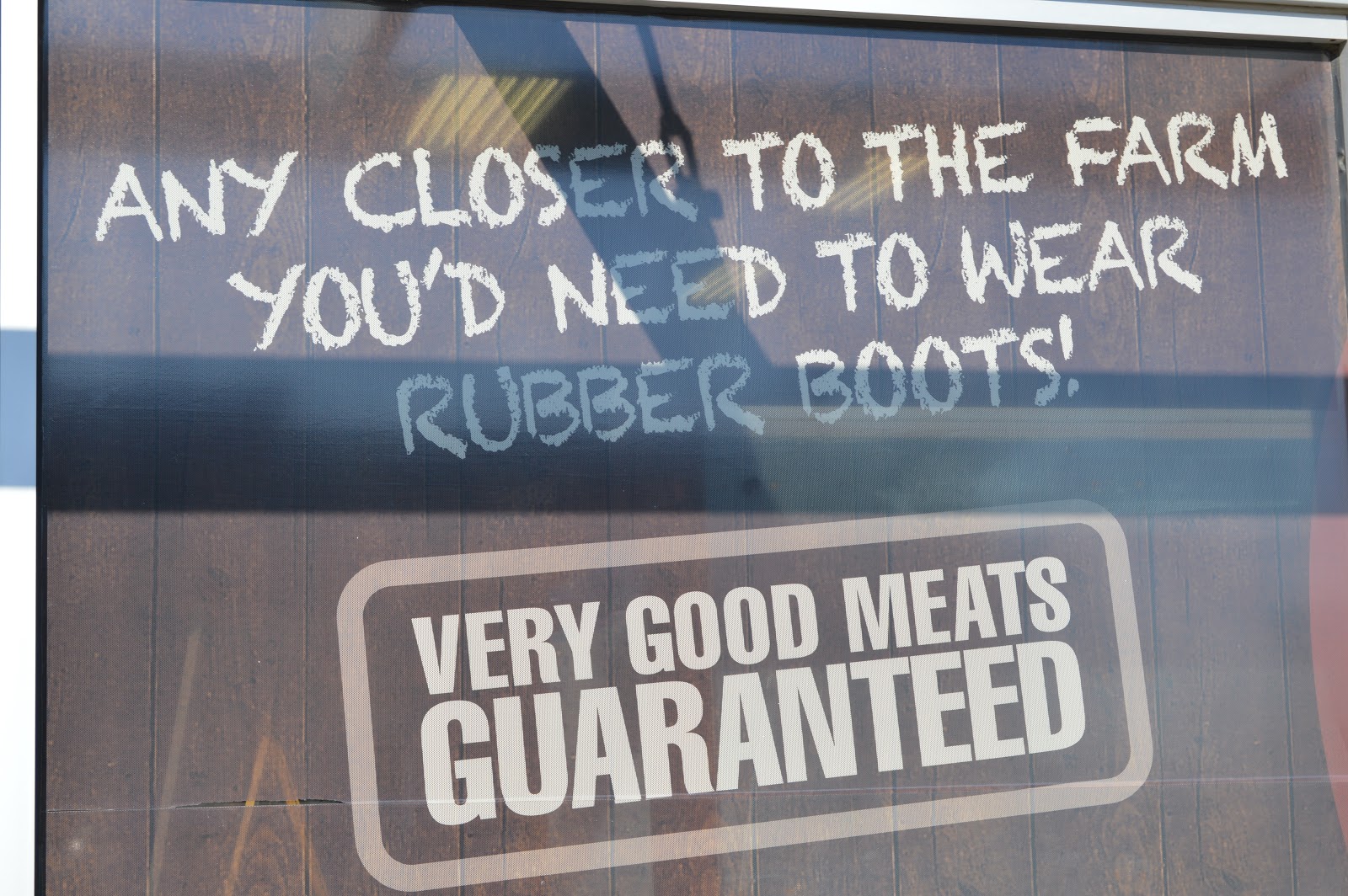
After this we boarded to coach and headed down to VG Meats at Simco.  This was a very interested business taking cattle from their farm and taking them through the processing system themselves to the customer.  It is a family run business with all the brother being involved.  The cattle are mainly Angus crosses, calving in May.  The theory of the business is quality, it's not low cost at all, but it seems to work.  The meat is taste tested with the best tasting carcases being sold to high end restaurants in Toronto.  The counter cut meat is hung for 21 days, but there is a maturing cabinet in the shop where customers can custom age their own meat, there was some in the hanging for up to 90 days!
The business is split 50:50 between retail and wholesale beef, with some lamb, pork and poultry in the shop as well, although the quantity of these is very small.  No hormones are used in this beef as it affects the eating quality, making it less tender.  It was a very interesting system, being fully integrated from the cattle feed lots right through to the end user.
After lunch the group split, heading in two directions to tow different winery's.  We headed out to Megalomanic wines on the Niagara Peninsular.  there we were met buy the very inspirational Sue-Ann Staff, who acts as a consultant and the main wine maker.  Sue-Ann, a fifth generation wine maker and Ontario's wine maker of the year in 2002, she also has her own winery Staff Wines  The passion that Sue-Ann had for the subject was incredible.  It was a lovely afternoon so we headed out to look at some vines being pruned.
The scenery was warm and stunning with lines of vines criss-crossing the fields. The area has a unique climate caused by lake Ontario keeping the very cold weather at bay, (still gets to -20 degrees C) but critically not much colder so the vines can survive.  In fact there is a new wine launched a few years ago called 'Ice Wine' that is created from grapes that are harvested when frozen.  People are employed to harvest the frozen bunches of grapes, in temperatures as low as -10! Grape vines yield anywhere between 1.5t/ha - 4t/ha and you need about 2x2m of leaf to create 1kg of grapes.  The story continued underground, a great way to avoid all the planning issues (- note to self), where the fermentation and creation takes place.
We tasted three wines, just a little taster, which was a really great fun.  I learnt how to hold the glass (by the stem) then swirl the wine in the glass before inhaling the aroma.  Then take a mouthful, not too little (good news) and swash around the mouth exposing the sensors on the tongue to the very unique flavours, then swallow!
It really was a great visit, very well hosted.  What was inspiring was the passion, knowledge and drive that Sue-Ann has for the subject, it is something that the whole group was very impressed with.  We loaded up and headed to the honeymoon capital of the world - Niagara Falls


Monday, 18 March 2013

Nuffield Contemporary Scholars Conference - Wednesday, Speaking Up For Agriculture

I was really looking forward to getting stuck into day 3 of the conference, a day entitled 'Speaking up for Agriculture'  Kelly Daynard works for an organisation called Food and Farm Care who are the voice of Agriculture sector bodies in the province of Ontario.  The organisation's role is to promote credible truthful, factual and real stories about the family farms of Ontario and to tell these stories to the customers who buy that food.  We heard how farmers are among the most respected in the community, after emergency service staff and veterinarians.  We heard how Kelly and the team are training farmers, old and young, ranchers and crop farmers, rural and more urban, to be willing and available to promote the industry.  This is about training them to speak to the media, go on television and write letters to the newspapers promoting their food and farming stories.  This training is moving out across Canada to British Columbia and Prince Edwards Island.  Food and Farm Care is also looking at other initiatives to engage with the public through Virtual Farm Tours , Faces of Farming Calendar and Lets Talk Farm Animals If 50 farmers took 10 minutes a day for 5 days of the week that would equate to a full time employee doing marketing for the industry.  Image what could be achieved in the UK or globally?
After Karen was Bern Tobin who was giving us media training.  What was the message we wanted to get across, how would we achieve that and did we need to bring in help form other people?  Bern told us to try and stick on message all times, to keep our game-face on throughout the interview and to be clear thinking and use language that could be understood by everyone.  He quoted Denzil Washington "explain it to me like I am a 7 year old" which is so very true and a comment I will remember and try and stick to. After Bern was Andrew Campbell who gave us an insight into Social Media.
I knew social media was big but I hadn't realised just how big!  Facebook (or FaceTube - #Nuffield13 joke) has 1 billion active users and twitter has 500 million users.  People are hungry for this method of engagement and short sharp communication!  We were warned though, information on the Internet is like toothpaste, once it's out of the tube it won't go back in!  I think I will be starting to use Instagram next so watch out for updates coming your way.
Agriculture More Than Ever is an industry cause to improve perceptions and create positive dialogue about Canadian agriculture.  George Klosler from Farm Credit Canada gave a great presentation about this organisation and how it is trying to raise the awareness of our great industry.  There are some really great video clips on their website showing the wonderful stories of how are food is raised or grown and by whom.  A huge thanks to FCC for sponsoring our shirts for the Nuffield group to proudly wear on our trip and he's Tafi Manjala from New Zealand very proudly displaying his new shirt! 
Len Kahn was next up, to tell us all about marketing ourselves.  We are the brand, how do we stand out in a very noisy world and how do we get our message across.  It was a great lesson all about PPEAS, Preparation, Practice, Eye contact, Appearance and Smile.
Last but by no means least we had a trio of local business people all at the top of their respective games from different farming sectors.  First up was Jackie Frasier (Middle) who runs Fraberts Fresh Food her message to me was be part of the community and focus on quality, quality quality.  There also needs to be a strong brand and there needs to be trust!
On the left (above) is Bruce Vandenburg, who owns Mariposa Dairy a company making goats cheese. The company has grown very quickly in the last 5 years with the help of one of the international supermarkets.  On the left we heard form Jason Verkaik who runs a 250 acres vegetable farm (Carron Farms) on the Holland Marsh.  Jason runs a fantastic business on rich soils growing many different vegetables including ones demanded by the growing the niche populations near Toronto, including East Indian Red Carrots.  Jason also started a harvest box scheme, as well as growing a wide range of crops from legumes to leafy greens, strawberries to gourds.
It was another long day and the last one in Guelph, so after dinner at the Borealis Grille it was time to explore The Ranch (Country and Western) bar, inhabited by a single Canadian and us.  After a hybrid Irish and Scottish country dancing, the staff very kindly started up the bucking bronco and we all had a go at staying on board!

Tuesday, 29 June 2010

Straight Talking

This truck was parked up in rural Ontario, in a small village called Manotick, just outside the capital city of Ottawa (Canada) and I had to stop and take a picture of it. I feel it demonstrates in a heartbeat a simple message, straight to the point.