Showing posts with label Dunedin. Show all posts

Wednesday, 18 December 2013

Monday and Tuesday with AbacusBio

A slight deviation from my Nuffield studies took me to Dunedin (this is the first church of Dunedin) to talk to a company called AbacusBio about a type of Carbon assessment for sheep flocks called Hoofprint.  I met with Jude Sise who is a partner at AbacusBio and who is running the Hoofprint program in New Zealand.  Abacus Bio is the science partner to Alliance and who’s philosophy is all about using science to help business.  Hoofprint is web based, and is currently used on about 50 New Zealand lamb producers supplying Alliance; one of the main farmer owned cooperatives operating in New Zealand.
The program requires very limited farmer input with the bear minimum requirement taking up about an hour or two a year.  This is involves putting the closing stock numbers into the system and adding the fuel, fertiliser and electricity usage into the system.  The real beauty of this system is that the kill sheet data is automatically added to the program through a system in place at Alliance.
Depending on the ability of the operator the system can be much more accurate, with regular inputs of sheep deaths, sales outside of Alliance making the carbon impact much more accurate.
But where this system scores highly, in my opinion is about the results that are generated.  There is a lot of scientific algorithms running in the back ground to calculate many of the figures used to generate the reports.  At the end of the year animal growth rates, carcase weights, and growth rates are all available.  In addition it reports on scanning, docking and sales percentages which call also be compared to previous seasons.  We know from previous experience that lower carbon foot prints equate to more efficient and profitable sheep production.  Take growth rates for example, the shorter time lambs stay on the farm the lower its carbon emissions, the lower the cost and the more efficient that animal is.
This is a great tool to monitor the flocks performance and it can even be split up to manage and monitor different flock or mob numbers.

I spent Tuesday morning back at the office running Overbury’s data through the program, from memory, which showed some interesting comparisons with New Zealand emission and performance data.  It would be interesting to get hold of the program to run a full years worth of data for our sheep enterprise to look at it’s performance against the top producers in New Zealand.

After leaving Jude and the Abacus team, I headed to the Otago Peninsular to try and find the resident Penguins and Albatrosess.  I failed miserably on both counts which was shame, so I about faced and headed towards Invercargill via the Southern Scenic Route, which should have taken about 4 hours but in true 'Jake the travelling tourist' mode, took me almost 7 hours!  However the stops were certainly worth making.

The first place to stop was Nugget Point (above) protruding out into the South Pacific Ocean.  The rocks, beautiful white sand, turquoise sea; punctuated with seagull and seal calls was simply stunning.  Pressing on from Nugget point I made my way along the very scenic route to another incredible view this time from Florence Hill, overlooking Tautuku Bay, which I arrived at as the sun was starting to set.
A few miles along the coast I came across Curio Bay, where the remains of a petrified forest can be seen on the rocky beach.  The fossilized trees are clearly visible, and are incredibly rare.  This is because the silification, brought by the flood, covered the forest in a matter of weeks or months before the forest material could degrade, preserving them for millions of years.

I made my way onwards to Fortrose where I met up with Hayden Peters who farms with his father and also works full time for Alliance, who had very kindly offered to host me for the night.  After a quick tour of the farm, as it was getting late we headed back to his house.

Monday, 16 December 2013

Days 19 and 20 - Weekend in Athol

After a slightly delayed start to the day Steve and I headed out to have a look around the home farm in Athol.  We started off catching up with some fencing contractors putting deer fence in around one of the paddocks before setting off to have a look at a new pivot irrigator.  It was a remarkably simple to operate with the pump on a variable speed drive, automatically switching on and off depending on the load required.  The pivot was irrigating spring barley.  Soil moisture probes are used to assess the deficit in the soil before deciding when to irrigate and with how much water.  Theses are quite integrated systems with probes located between 100mm and 450mm and a second one between 450mm and 800mm. The barley looked a stunning crop with great yield potential.
The next part of the trip round Steve took me to see the Red Deer side of the business, which is quite diverse.  Deer are kept for a number of reasons, for breeding stags, for velvet and for venison; most of which ends up in Eastern Europe and Germany.  Here Steve has some deer velvet being stored in the freezer.  It is quite valuable but is slow to grow and difficult to harvest.  Only licensed operators are qualified to remove the velvet, after anaesthetic is administered to the deer.  I was fascinated to hear about the production systems and rounding the deer up form the hill using helicopters!
After lunch we headed down to Balfour to have a look at some arable crops, the first couple of fields being a direct comparison of direct drilling and traditionally ploughed and cultivated.  The direct drilling looked a lot thinner but better bigger ear numbers whereas the ploughed looked to have much more biomass in the bottom and smaller ears.  It will be interesting to see what the combine yield monitor says, in February!
We stopped at the main farm yard where Steve and family run another business, processing and selling grain to dairy farmers.  The barley and wheat are rolled, and if necessary minerals are added before being shipped out on one of the farms trucks.  This has turned the Southland area into a net importer of grain.  Before this plant was running wheat traded at a $50 discount to wheat in Canterbury because of the haulage.  Now all the wheat is being used locally, wheat is being pulled down from Canterbury, creating a shortfall in this area resulting in a price increase.
I headed East on Sunday morning after saying goodbye to Steve and Heather, but not before calling in to the Veg Shed to pick up some supplies for the journey, knowing how long it took me to get here!  A huge thanks to Steve and Heather for providing a base to take a breather, just what was needed!  I left Athol and retraced y steps back up towards Queenstown and Cromwell before turning south East towards Alexandra.  The scenery heading over the Knobby Range was stunning.  Large rocky outcrops with clear water lakes and sheep dotted on the escarpments.  Proper Lord of the Rings territory.
I stopped and detoured over a bridge across the river Clutha to show the crystal clear water carving it's way through the steep sided gorges. This was taken at Millers Flat and the colour of the water was almost luminous.
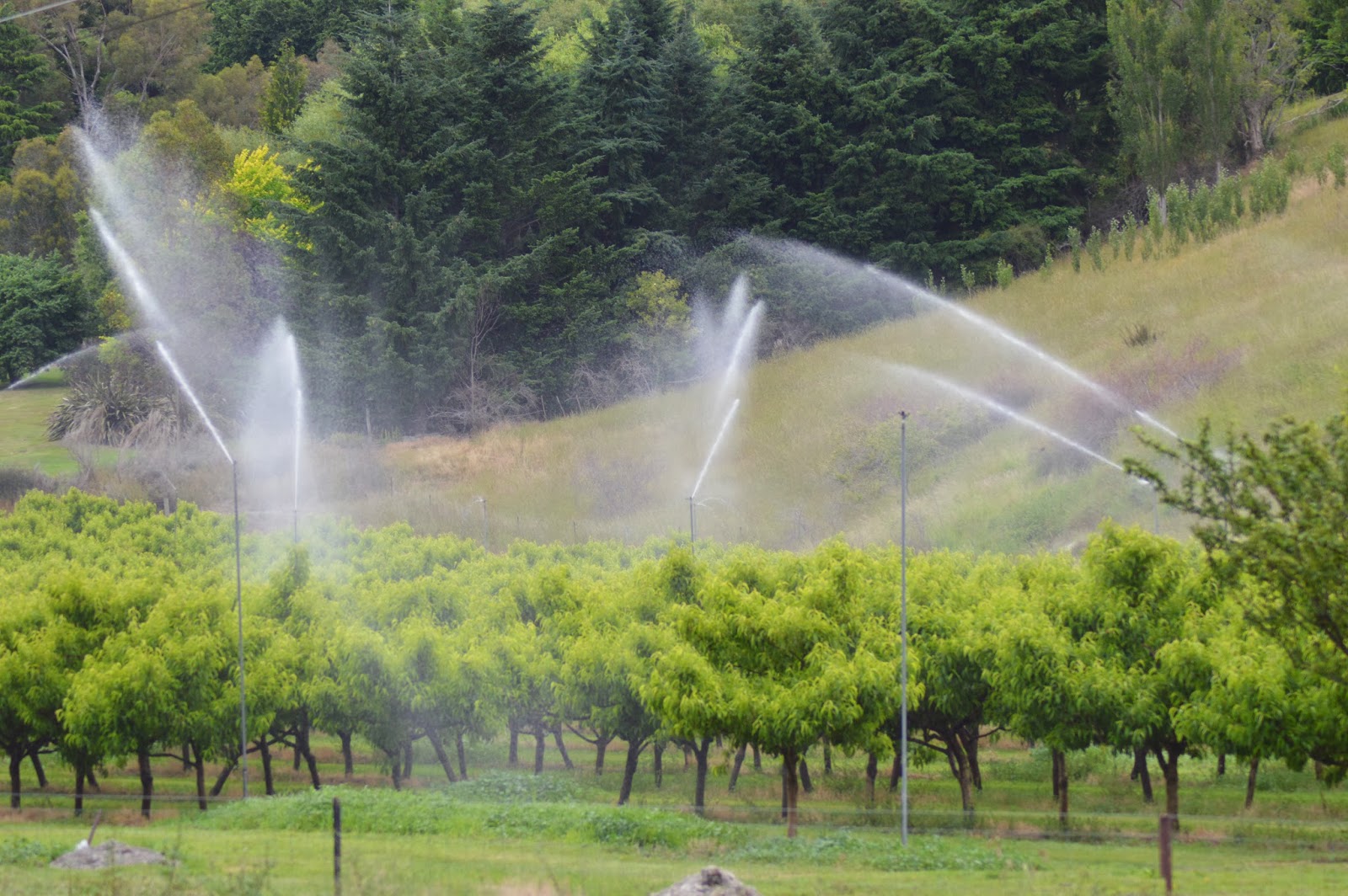
All along the river on the flat alluvial soils where water was available there were fruit farms, irrigating merrily in the hot afternoon sun.  This area of Central Otago is known for its top fruit of cherries, apricots, wines, peaches, pears, plums, nectarines and apples.  There were lovely little market garden stalls open along the roadside selling very local and very fresh produce.
I pushed on through Lawrence and Milton, where I stopped to take a picture of a classic tractor collection, totalling at least 12 vintage tractors, trucks and crawlers.  All were immaculately restored and maintained.  For any passing Ford fans it's definitely worth a visit.  I headed on into Mosgiel, on the outskirts of Dunedin to find a fellow Nuffield Scholar who has kindly offered to put me up for the night ahead of meetings tomorrow morning in Dunedin itself.