Showing posts with label Irrigation. Show all posts

Monday, 16 December 2013

Days 19 and 20 - Weekend in Athol

After a slightly delayed start to the day Steve and I headed out to have a look around the home farm in Athol.  We started off catching up with some fencing contractors putting deer fence in around one of the paddocks before setting off to have a look at a new pivot irrigator.  It was a remarkably simple to operate with the pump on a variable speed drive, automatically switching on and off depending on the load required.  The pivot was irrigating spring barley.  Soil moisture probes are used to assess the deficit in the soil before deciding when to irrigate and with how much water.  Theses are quite integrated systems with probes located between 100mm and 450mm and a second one between 450mm and 800mm. The barley looked a stunning crop with great yield potential.
The next part of the trip round Steve took me to see the Red Deer side of the business, which is quite diverse.  Deer are kept for a number of reasons, for breeding stags, for velvet and for venison; most of which ends up in Eastern Europe and Germany.  Here Steve has some deer velvet being stored in the freezer.  It is quite valuable but is slow to grow and difficult to harvest.  Only licensed operators are qualified to remove the velvet, after anaesthetic is administered to the deer.  I was fascinated to hear about the production systems and rounding the deer up form the hill using helicopters!
After lunch we headed down to Balfour to have a look at some arable crops, the first couple of fields being a direct comparison of direct drilling and traditionally ploughed and cultivated.  The direct drilling looked a lot thinner but better bigger ear numbers whereas the ploughed looked to have much more biomass in the bottom and smaller ears.  It will be interesting to see what the combine yield monitor says, in February!
We stopped at the main farm yard where Steve and family run another business, processing and selling grain to dairy farmers.  The barley and wheat are rolled, and if necessary minerals are added before being shipped out on one of the farms trucks.  This has turned the Southland area into a net importer of grain.  Before this plant was running wheat traded at a $50 discount to wheat in Canterbury because of the haulage.  Now all the wheat is being used locally, wheat is being pulled down from Canterbury, creating a shortfall in this area resulting in a price increase.
I headed East on Sunday morning after saying goodbye to Steve and Heather, but not before calling in to the Veg Shed to pick up some supplies for the journey, knowing how long it took me to get here!  A huge thanks to Steve and Heather for providing a base to take a breather, just what was needed!  I left Athol and retraced y steps back up towards Queenstown and Cromwell before turning south East towards Alexandra.  The scenery heading over the Knobby Range was stunning.  Large rocky outcrops with clear water lakes and sheep dotted on the escarpments.  Proper Lord of the Rings territory.
I stopped and detoured over a bridge across the river Clutha to show the crystal clear water carving it's way through the steep sided gorges. This was taken at Millers Flat and the colour of the water was almost luminous.
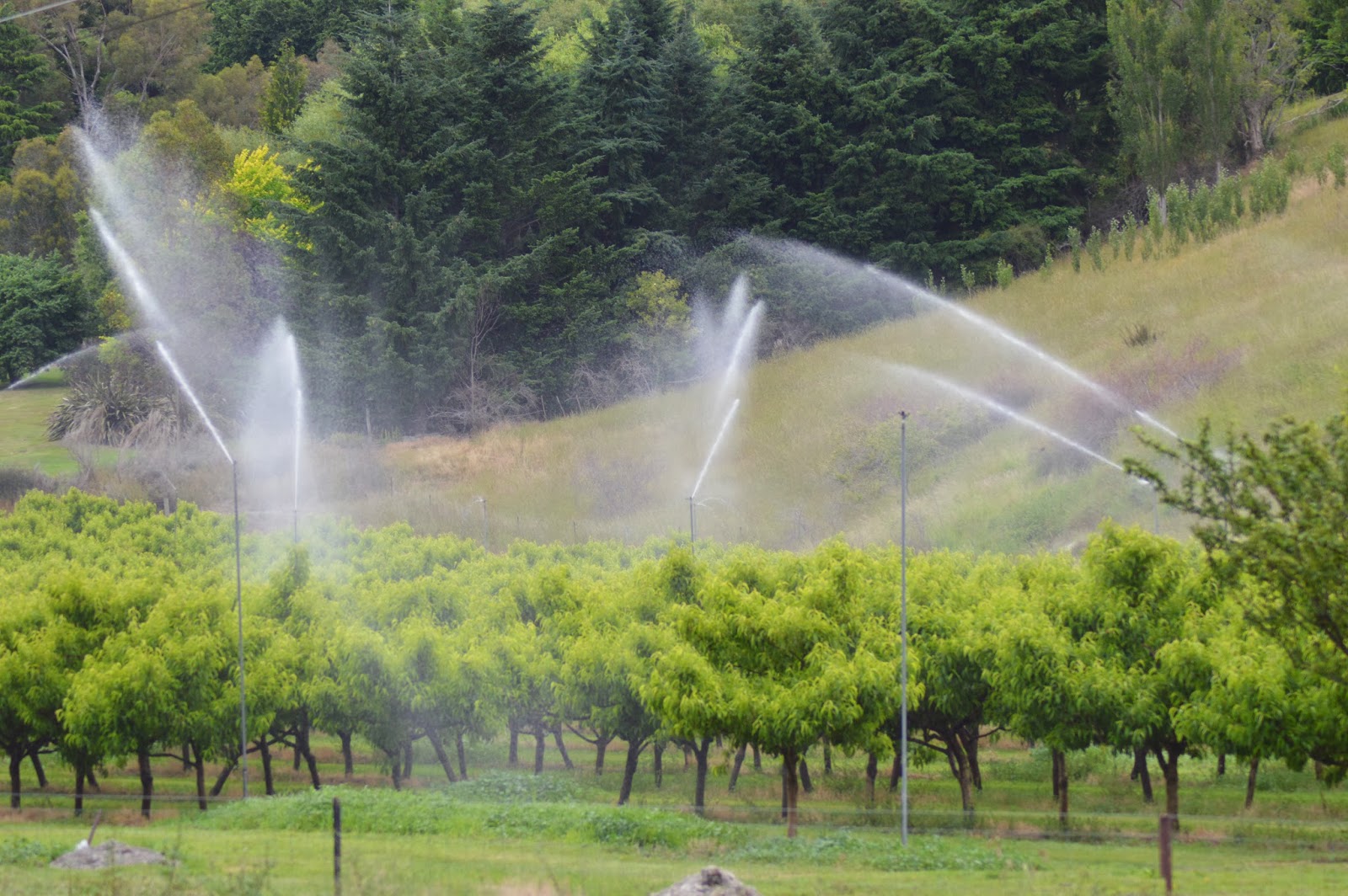
All along the river on the flat alluvial soils where water was available there were fruit farms, irrigating merrily in the hot afternoon sun.  This area of Central Otago is known for its top fruit of cherries, apricots, wines, peaches, pears, plums, nectarines and apples.  There were lovely little market garden stalls open along the roadside selling very local and very fresh produce.
I pushed on through Lawrence and Milton, where I stopped to take a picture of a classic tractor collection, totalling at least 12 vintage tractors, trucks and crawlers.  All were immaculately restored and maintained.  For any passing Ford fans it's definitely worth a visit.  I headed on into Mosgiel, on the outskirts of Dunedin to find a fellow Nuffield Scholar who has kindly offered to put me up for the night ahead of meetings tomorrow morning in Dunedin itself.

Monday, 9 December 2013

Nuffield Travels Day 14 - Another World Class Farm!

Monday morning soon came around after a late night writing a couple of blogs, packing up, doing some washing and getting ready to take Tom to the airport.  We took the scenic route over the Rakaia gorge to see what effects the previous days rain has had on the flow rates.  There certainly was a lot more water gushing through the narrow gorge before the river widened out further down strewn.  It's one thing I have really noticed about he main rivers in New Zealand is their sheer width but also the fact that they run fairly shallow.  The rocks and shingle that litter the river beds must be constantly changing.
Even after yesterdays rain fall, the sprinklers, rain guns, pivots and rota-rainers were all in action again today.  They are part of the landscape here, gently delivering the life giving water to the crops.  Without the water, the plains would be sparsely populated with sheep and beef, with very little intensive agriculture.  After dropping Tom at Christchurch airport I headed out to meet Nuffield Scholar Craige Mackenzie who lives and farms near Methven.  
Craige and wife Roz, farm dairy and arable in a very precise way.  Craige is passionate about growing the best crops that he can on his various soil types.  Variable rate technology is employed to manage inputs, including water across the farm paddocks.  Soil types have been mapped to enable water to be applied to different nozzles depending on where they are (gps) across the paddock.  Maps generated through the green seeker system are also used to variably apply growth regulators and even fungicides to optimise the performance of the crop in a specific area of the field.  This is great news for the business's financial performance and also the environment.  Take the VR Irrigation as an example.  By knowing the water deficit at the start of the season and only irrigating to a point below field saturation (i.e. when runoff or drainage works) all the nutrients applied to the field are retained in the field.  This information is monitored remotely and can be sent to Craige's phone where ever he is in the world!  The precision farming aspect of the family business is run through a company called Agrioptics  If you are interested in precision agriculture then tho sis definitely worth a look!
We looked in at a very special field of wheat.  The plant population and the management of the crop has been exceptionally well thought out and planned.  who's knows what the yield potential is here, only time will tell. 


Friday, 6 December 2013

Nuffield Trip Day 10 - 2 Exceptional Operators

Thursday the 5th of December and Tom and I first headed down around Ashburton to visit the first of two first class farmers operating Cross Slot drills.  First up was David Ward who has been using the Cross Slot System since 1995.  The farm is a silt farm over gravel/shingle with irrigation. The farm soils are only able to hold 80mm of stored water and when the heat comes on with North Westerly winds and hot temperatures evapo-transpiration can be as high as 8mm/day, so the irrigators need to get around the farm once a week.  David farms about 950 acres, with help from three employees, growing rye grass seed, clover seed, oilseed rape (hybrid - seed), vining peas, radish seed, spring barley, winter wheat and spring wheat.  The farm also carries and finishes 20,000 fat lambs through the winter on ryegrass and oat based cover crops and also takes weaned deer through to market weights.  The production numbers were staggering, with yields around 12T/ha of winter wheat and 11t/ha of spring barley.  I was starting to ask myself why bother with winter crops when lambs can be fattened off cover/grass crops adding to the margin/ha of a short season crop?  Might this work well in a black grass situation?  I need to think outside the conventional box when I get home!
The soil we dug up in every field was in fantastic condition, a sweet smell, lots of little worms and plenty of nodulation on the pea roots.  The crop; yes it was watered, looked stunning.  It had an even germination and was rocketing through the growth stages in the warm weather.  It was clean, even, and full of yield potential.  Still a long way to go!  We moved on to another draw dropping crop, this time of spring barley.  David put the potential yield at 11t/Ha and I would not doubt that.  The crop was planted after a winter break crop, direct drilled, and it has not looked back.  The leaves and stems were clean, disease free and stiff.  The heads were billiard table flat and not a weed in sight.
On the other side of the road we stopped to look at an organic farm that David has been asked to farm conventionally for  couple of years to 'sort it out'.  We dug some soil up which had recently been cultivated and left fallow ready to plant.  The tilth was very fine and had no structure.  If there was any kind of heavy rain event it would have slumped and capped, squeezing the air and the life out of the soil.  If the wind started blowing from the West, then a layer of topsoil would send up in the sea, through wind erosion.  I have to say it wasn't the best advert for organic farming.
The organic matter on David's soils have been increased from 2.8% 20 years ago to over 4% now.  This is helping store more valuable water in the soil, but it is not a particularly quick process and needs a mixed rotation and livestock putting some organic matter back into the soil.  The crop below is of hybrid oilseed rape seed production and will receive about 240mm of irrigation water through the growing season, which is staggering, but these farms are kitted out with high cost centre pivots or walking irrigators.  But the returns are worth the capital cost many times over with high value crops, good yields and good prices.  You have to ask how environmentally sustainable is this constant extraction of water from the underground aquifers? Can this practise continue at this pace for the next 10, 20 or 50 years?  The politicians are starting to look at extraction quantities, the environmental impact, and the potential election of the Green Party may force changes in production systems in the Canterbury area.  This could have an impact on UK seed supply as many of the varieties we grow are sourced from New Zealand seed stocks.  Less water use could see a reduction in output and therefore less seed and what seed will be produced could be exported to other countries or we'd end up pay more more for our seed.
After the flat land and soils,which reminded me of the silt soils of Lincolnshire only shallower and over shingle, we headed south of Timaru to St Andrews to meet Mike Porter.  Mike has a dry land farm, annually receiving only 22 inches of water just off the East coast in the rain shadow of the Western Mountains.  Mike harvests around 400 Ha on his farm and runs a flock of breeding ewes around on some permanent pasture.  Like many New Zealand farmers Mike stubbled during the late 1980'sduring the de-regulation, when subsidies were cut over night and the dollar was devalued by 20%, to make the country more export competitive.  This, coupled with interest rates of 20% and the worst drought in 40 years (88/89), broke many farmers and almost took out Mike as well.  Since then he has developed a great farming system revolving around the cross slot drill, reducing cost and also increasing return per hectare.  Don't forget it's all about profit per hectare rather than out and out yield!
Mike's farm reminded me of my time in Idaho with rolling hills and slopes of around 26%.  Mike farms feed wheat (8t/Ha) and barley (6,5T/Ha), oilseed (3.5T/Ha) and rye grass with a small area of vining peas seed (3T/Ha).  The system is very integrated with the lambs being fattened on ryegrass stubbles or green feed oats, through the winter and forage rape in the summer.  The crops are established by just spraying off the previous crop and direct drilling into the stubble or residue.  Mike does roll everything to reduce the threat from slugs and also uses, usually one, dose of slug pellets.  This is an interesting shot looking up a bank where the tractor has had a higher level of wheel slip, the forage rape seems to be more forward.  I think, and I'm not sure, that this is due to mineralisation of soil carbon due to soil movement under the tyres releasing nitrogen which the crops picking up.  In a couple of weeks the difference would have disappeared as the crop evens up.
Mike supplies Canterbury Meat Packers who are a dedicated supplier of New Zealand Lamb into Waitrose  of which Mike is obviously very proud.  The oats can grow about 3-4,000 Kg of dry matter in the autumn which can be stocked at around 12 stock units per hectare.  The lambs feeding on the forage rape are growing at around 300-350g/day which is very acceptable, and are stocked at around 70/Ha with back fencing which allows some regrowth and a secondary grazing.  In comparison to David's soil, Mike's deep clay soils can hold up to 220mm.  Interestingly starter fertiliser is used to establish the fodder rape making Potash available to the new seedling as soon as it germinates.  Something that the Cross Slot is able to do at ease.
This pivot irrigator is irrigating grassland for a diary conversion on a neighbouring farm and is probably the only one in the southern hemisphere working on such steep banks.  At the moment Mike is in a red zone for irrigation, i.e there are no local plans in extend the area available to irrigate.  A huge thank you to David and Mike for giving up their time to show us around their farms.  Although very different farms;  attention to deal, passion, hard work and the love of farming and growing were evidently common place in these excellent farmers.

Tuesday, 3 December 2013

Day 8 - Time for a Tour of the District

Our host Alec Wright; Nuffield Scholar, in Methven graciously showed us around the district this morning visiting his sons farm first thing to drop off some lunch made by Jean, Alec's wife. We looked at the silage operation before moving up to some higher and stony ground to look at some direct drilled grass reseed.  This field was coming up beautifully due to the reduced disturbance retaining moisture win the soil.  There is no luxury of irrigation this far up the slopes on Mt Hutt. The swedes were also direct drilled into grass stubble that had been sprayed off and were emerging well on the whole although as temperatures reached 29 degrees today and with a stiff breeze soil moisture was paramount.  This would also go for wheat production.  A single cultivation will reduce the soils water holding capacity by 25mm, which could be important later on in the season.
If cultivated and a North Westerly gale blows, the wind is funnelled down through the mountains and the soil will be eroded by the wind, leaving the field and being caught up by the nearest obstacle, in this case a small hedge.  The depth of this top soil was 2 ' deep and seeing this brought back thoughts of the great dust storms of the 1930's and my time in Oklahoma.
The wind can also do some serious damage to the infrastructure of the farms when really unleashed.  Earlier this year about 800 irrigators were blown over during winds that reached 200Km/hr in places. This is putting huge pressure on the mechanics required to repair all this damage but without water there are no crops or grass.  Production in some areas has fallen away simply because there is no water to keep the crops alive.
We drove passed one terrific looking crop of wheat being irrigated.  The plant population was thinner than our UK target but the plants had tillered out very well.  The stems and upper leaves were clean of disease and the potential of thigh yield was definitely present.  I think  this picture sums up the advantage that New Zealand has over the UK when it comes to wheat production.  It seems that an abundance of water, (for the time being), and lots of sunshine are the key ingredients to very high yields.  But the plants need to be fed correctly and the soil has to have the correct structure to support root development that will enable faster, less restricted uptake of nutrients. 
This is where crops like this fodder radish can help in restructuring the soil.  The tap root, along with the other 30/m2, are all pushing down through the soil profile, finding a way through any compacted layers in search of water and nutrients.  The field had a good population of plants all creating drainage for water infiltration, for when it does rain, and removing any compaction layers.  The obvious next step would be to direct drill the next crop to reduce the erosion risk; as evident above, reduce cost of establishment and increase the amount of water available to the following crop.  By not tilling; the soil will increase it's organic matter content allowing further increases in the water holding capacity.  Seems to me like a good way to progress?

Monday, 2 December 2013

Day 7 of NZ Nuffield Adventures - Horticulture

Slightly later than planned we started off around Julian's farming operations along the coast from Nelson, nestled behind Richmond, over looking he Tazmin Bay.  To say the business is diverse would be an understatement and we could have spent days not hours looking around!  As always it was great to see Julian again after meeting for the first time at the Contemporary Scholars Conference in March and to me it sums up what it means to be part of the Nuffield Family.  We started off on the lower ground looking at apples and the Boysen Berries. Julian grows 75 acres of this fruit, a cross between logan berries, raspberry's and black berry's, all of which need to be harvested in a 28 day period.
The first 'pick' should be ready in about 2 weeks and then the bushes are mechanically harvested every few days.  The harvesting machine will travel through the crop 7 or 8 times, gathering during peak production 1T/hr of fruit.  The fruit is then sorted on the harvester, transported and processed back at the farm yard.  Some berries are individually frozen whilst others are stored in larger containers for canning or processing.
In addition to the Boysen Berries Wai West, (meaning water in Maori) grows Kiwi's, Hops and Apples.  With 250 acres of apples the business is gradually moving into varieties that are popular with the Asian markets in preference to those markets in Europe.   Asia is certainly an emerging market that Wai West is looking to supply with lots of different products.  Here's Julian, Tom Sewell and myself looking down across the farmland and onto the Tazmin Bay.  Nelson the nearest large city is across to the right and is the largest fishing port in Australasia.  
One of the other enterprises that has just been launched is selling liquid milk through vending machines.  I bought a bottle and filled it up through the machine to take on the 6 hour journey to Methvin, later that day. I loved the pictures of the cows on the bottle and the idea of taking whole milk out to all the customers in the form of a vending machine.

With the full milk bottle in the back of the chariot we set off for the 500Km drive from Richmond and Nelson to Methven in the Canterbury area near Christchurch.  Our route took us along the Maruia river and over Lewis Pass, down passed Hanmer Springs and then towards Christchurch.  
We noticed lots of interesting aspects of the Agriculture along the way, the main one being the amount of irrigation being used to grow the grass for the dairies. There were centre pivots, rain guns and sprinklers running in every direction.  It will be interesting to explore this use of natural resource as my studies here continue, especially in the arable sector which I will be concentrating on over the next couple of weeks.

Thursday, 12 May 2011

Farm Update


The last couple of months have been a difficult time on the farm with unprecidented low levels of rainfall during two important months.  At the start of March we were all very delighted with the dry spell of weather, great for spring barley drilling, potato planting and of course for lambing.  As the weeks rolled on and the temperatures rose the light arable land really started the run out of water.  Fertiliser that we had applied just sat on the surface so crops were unable to use the nitrogen and insect pests were multiplying in the warm spring sunshine.  Our newly planted trees, both in the orchards and the elm trees, required watering in order to keep them alive!  Once started this job will need to carry on but with the investment in the trees we have to keep the going.  Irrigation has been intense on the salad onion crops and today we have started on the potatoes.  Our rainfall for March was only 8.6mm (driest in 60yrs) and April was even less at 5.4mm (long term average for April is 49.5mm)

The large cracks opening up in the fields are usually only seen in the summer months and this photograph was taken in mid April!  It just goes to show how the weathers unpredictability impacts on our farming systems.  As a rule our climate is not used to weather changes like this.  Other areas of the world, like Australia and America, would expect these droughts much more often than us.  It will be a very interesting season as it progresses, just what will the effects be on yields and quality be?  It is still a long way to go but with the final leaves out in wheat crops (visible in April) 3 weeks ahead of usual there must be an affect, at the very least an early harvest.
Last weekend the rain arrived giving a very welcome 24mm.  This rain was the right kind of rain, silly statement you all scream but it was gentle and warm.  This gave it time to actually soak into the ground rather than run-off taking fertiliser with it into the nearest water course.  The situation had eased slightly but more rain will be required to get these crops to harvest, and it might even have come too late for our malting barley, which is looking thinner and thinner.

Friday, 23 April 2010

Watering The Onions

With all of this dry weather we have been asked to start watering the onions. The northerly winds have really dried out the land very quickly, going from muddy wet conditions at the end of March to bone dry conditions in about 3 weeks. These onions were planted about 2 weeks ago and are being watered for the second time already. This watering will help the small seeds to germinate very quickly and there is no real rain on the horizon for at least a week! They are due to be harvested in August. We could really do with some rain, gentle warm rain that is, very soon to help wash in some recently applied fertiliser on the spring barley and to get the grass growing again. The cold nights have also slowed up the grass growth with is not great for the ewes providing milk for the hungry lambs.

Thursday, 26 April 2007

Water?

We are just about to start irrigating our newly planted onions for a second time and we're still only in April! With only 7mm rain so far this month, things are really dry and a continued dry spell will put the irrigators under-pressure. Watch out for the first hose pipe ban of the year coming soon! With the right weather these onions will be on the super-market shelves in 10-12 weeks.

The potatoes were having their first irrigation scheduled for the 25th May although talking to Henry today that will almost certainly shift forwards if no significant rainfall appears.