Tuesday, 26 March 2013

Nuffield Contemporary Scholars Conference Saturday - Putting it All Together

The final part of the conference was arguably the best.  We were split into 6 groups to work together on a presentation for the other groups.  We were given two hours to work out a plan; in our case, "Telling the Story of Agriculture", then we had a 15minute presentation and a 10 minute grilling from everyone else.  We looked at the voice that agriculture has in the world, from Facebook groups promoting agriculture to those in opposition and it really was frightening the balance of opposition to agriculture.  We looked at Twitter, at YouTube and how we as scholars can help influence the positive side of our great industry.  What amazed me was that all the scholars are having the same thoughts and issues, no matter where they come from in the world.  The rural population is in decline, the age of our farmers is increasing and our voice is getting lost in the general 'noise' of our modern world.  It's not all doom and gloom though there are some beacons shining in the darkness telling our side of the story.  We need to do more of it, maybe with one international agriculture brand? It was a very good finale to the Conference and one that inspired a very good 'take home' message to us all.  Some were really shocked at the statistics.......
The evening was spent in the Skylon Tower over looking the Niagara falls where we all mulled over the information we had taken in during the week.  I was amazed at how quickly the week had gone, spent with a really tremendous group of friends.  Friendships that will last a life time even though we've only just met.  Friendships that will be built on over time, meeting up around the world, during our individual studies and long into the future.
The view form the tower was a stunning setting for the final talk of the week from Steve Larocque who owns a company called Beyond Agronomy.  Steve was a Nuffield Scholar from 2008 and manages over 30,000 acres in Alberta.  Steve has taken his Nuffield experience to the highest level, looking after a wide range of crops, including wheat, barley, canola, beans, lentils and peas, as well as setting up his own farming business.  He is a huge advocate of Controlled Traffic Farming and looking after the soil at all times.  It's a system that has the greatest resilience to climate change and one that we need to be looking into more and more in the UK.  It will be a nice side line as part of my 20:20 project!  
Steve gave us an example of one of his spring barley fields with 650 ears/m2 with 60 kernels/ear which when harvested yield 12T/Ha.  Now that is very impressive and a target to aim for and one that needs more investigation.  What can I learn for the UK situation?
Steve left us with a couple of quotes; one I especially like is from Lloyd Alexander, an America author, he said; "we learn more from looking for the answer to the question and not finding it, than we do from learning the answer itself".  I guess this sums up my Nuffield adventure so far.......

Friday, 22 March 2013

Nuffield Contemporary Scholars Conference - Friday The Global Environment

Up bright and early on Friday morning we headed out to VineTech Canada to meet Wes Wiens.  Wes runs a great business producing vine stock for other vineyards to plant.  He has about 20 acres with over 1.7 million vine plants growing at at any one time. Usual vineyard planting will be about 1361/acre.  There were two main things I took away from our visit to Wes's farm, firstly the backbone of his business is made on producing quality vines.  These varieties are sourced from around the world, including Germany, France and the US.  He ships vines to the main wine producing areas in Canada namely, British Columbia, Nova Scotia, Quebec and Ontario.  The vines are puzzle cut and then grafted onto rootstock before being planted out in the nursery usually for a year.  Wes sells most of the vines having been grown on under his control so there is less chance of them failing in the first year, again more work but quality ensured.  The second memory was how Wes looked after the 45 foreign workers employed during the busiest time of year.  Birthdays are recognised; and as many of the workers are foreign (Mexico and Bulgaria mainly), they are also encouraged to learn to read and write.
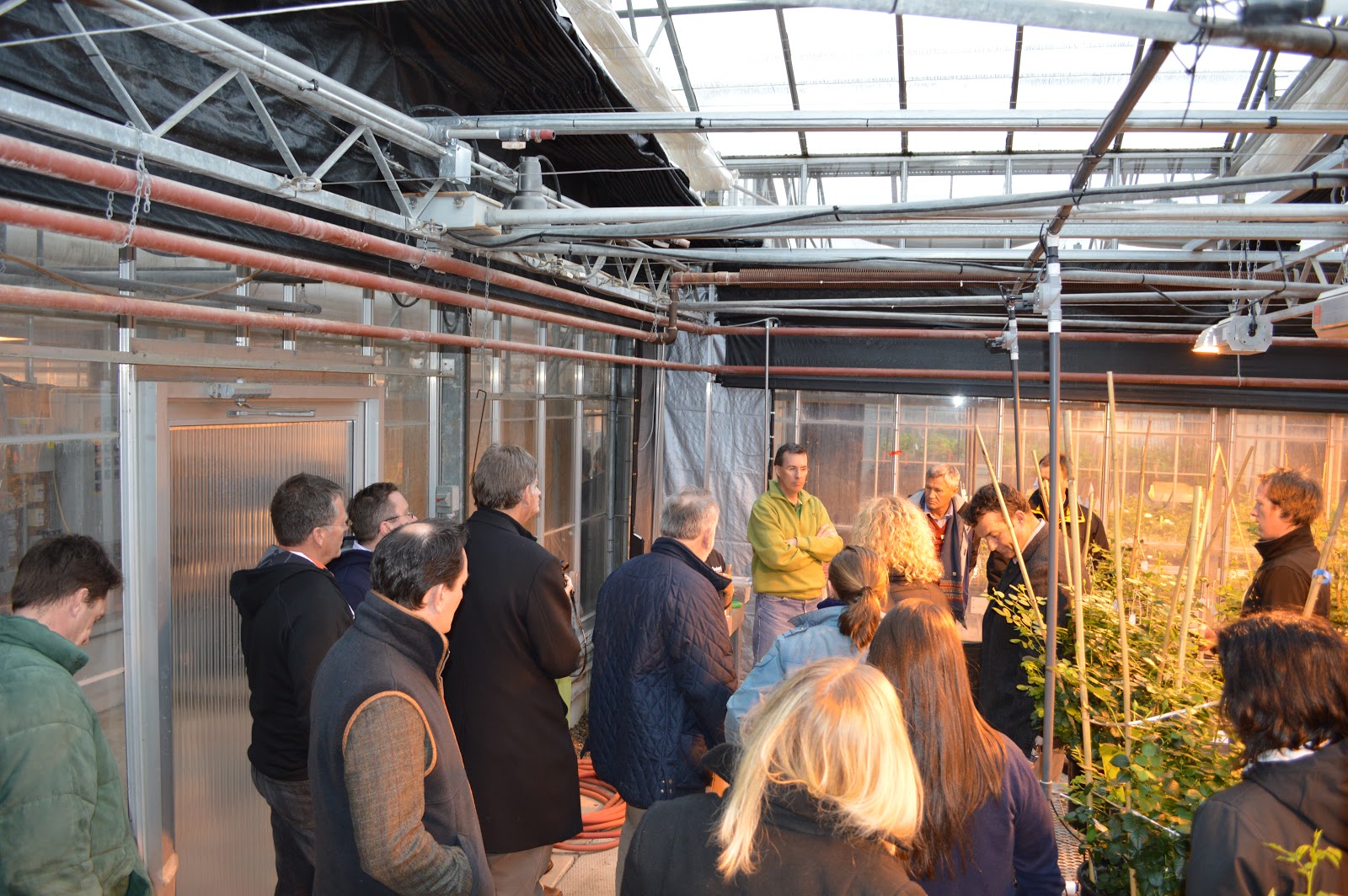
After a short bus ride we headed off around the Vineland Research and Innovation Centre which is a not for profit institute. A substantial amount of money is raised through commercial research and government funding. One of the major research projects currently underway is to increase the winter hardiness of roses 'out west'.  Another project that has born fruit was developing a new apple with funding generated through the Ontario Apple Growers.  The centre has a trained panel of tasters to have the ability to try out and benchmark new flavours, which meets up a couple of times a week.
Here's Steve Wilkins from New Zealand at the Vineland Research Institute.
The roses in the breeding programme that we saw were in greenhouses being marked with different tags depending on their genetics and the characteristics that were being identified. It is hoped that a new rose might be commercially available in 2018, which is a long time to wait for a winter hardy rose bush.
After lunch we had a great talk by Andrew Novakovi on the United States Farm Bill.  The farm bill was put in place as a support mechanism for farmers many years ago and is amended every 5 to 7 years.  The first Farm Bill was started by President Roosevelt following the stock market crash of 1929, at a time of the dust bowls in the mid west.  It's role was to set out the the responsibility of the government.  The farm bill looks after, wheat, corn (maize), grain sorghum, barley, oats, upland cotton, rice, oilseeds, soybeans, sugar and peanuts.  The bill also spends money on nutrition, commodities and conservation.
Another aspect of the farm bill is for crop insurance where growers pay an area insurance policy.  This means that the income from the crop is secured so if your state goes into drought, then you are eligible to claim the value of insured crop.  This year between $20-$50 billion were paid out to US farmers due to the drought conditions! The US government knows that this level of subsidy payments can't continue but the farmers have a very strong voice when it comes to lobbying the politicians.  It will be interesting to see where the next negotiations go and how much money is available.
Jay Nutting was up after Andrew to talk about the role of the lobby in politics.  Jay is an Eisenhower Fellow a similar sort of scheme to Nuffield. Putting a point across is something we as industry need to do more of, no-one is going to do it for us.  Making local connections and being the 'go to' person who is straight forward and knowledgeable is what we, as Nuffield scholars need to do in our own communities and try to have influence over our own political masters.

Tuesday, 19 March 2013

Nuffield Contemporary Scholars Conference - Thursday 'Evolving for and Urban Setting'

Thursday morning arrived way too soon.  Although the start was early everyone was up and ready to go.  We had to check out of the Guelph Delta hotel and board the bus by 8am.  Our first stop was Cranston Farms, a herd of 70 cows or so managed and owned by Doug and his wife.  The cows are housed all year round in a great light and airy barn. These buildings called 'Coverall's' a strong plastic type of material stretched over a aluminium or steel frame.  These were invented to withstand tornado's so that the fabric rips off in the wind.  A building this big can be re-roofed in a matter of hours!
The bedding was a unique mix of dry wall (I think the same sort of material as plasterboard) and dung. As the mixture builds up; being cultivated everyday, it composts down before being removed from the building.  The final 4' against the back wall is then spread out with a good supply of bacteria to start off the composting process again.  Housing cows all the time is a very contentious issue in the UK, but these cows were very happy and is standard practise here in Canada.  Everything the cows need is provided, including a vet, who happened to be on site, pregnancy testing the cows.  The ration was a complete TMR (total mixed ration) with maize, flax, soya and cotton, shown below.
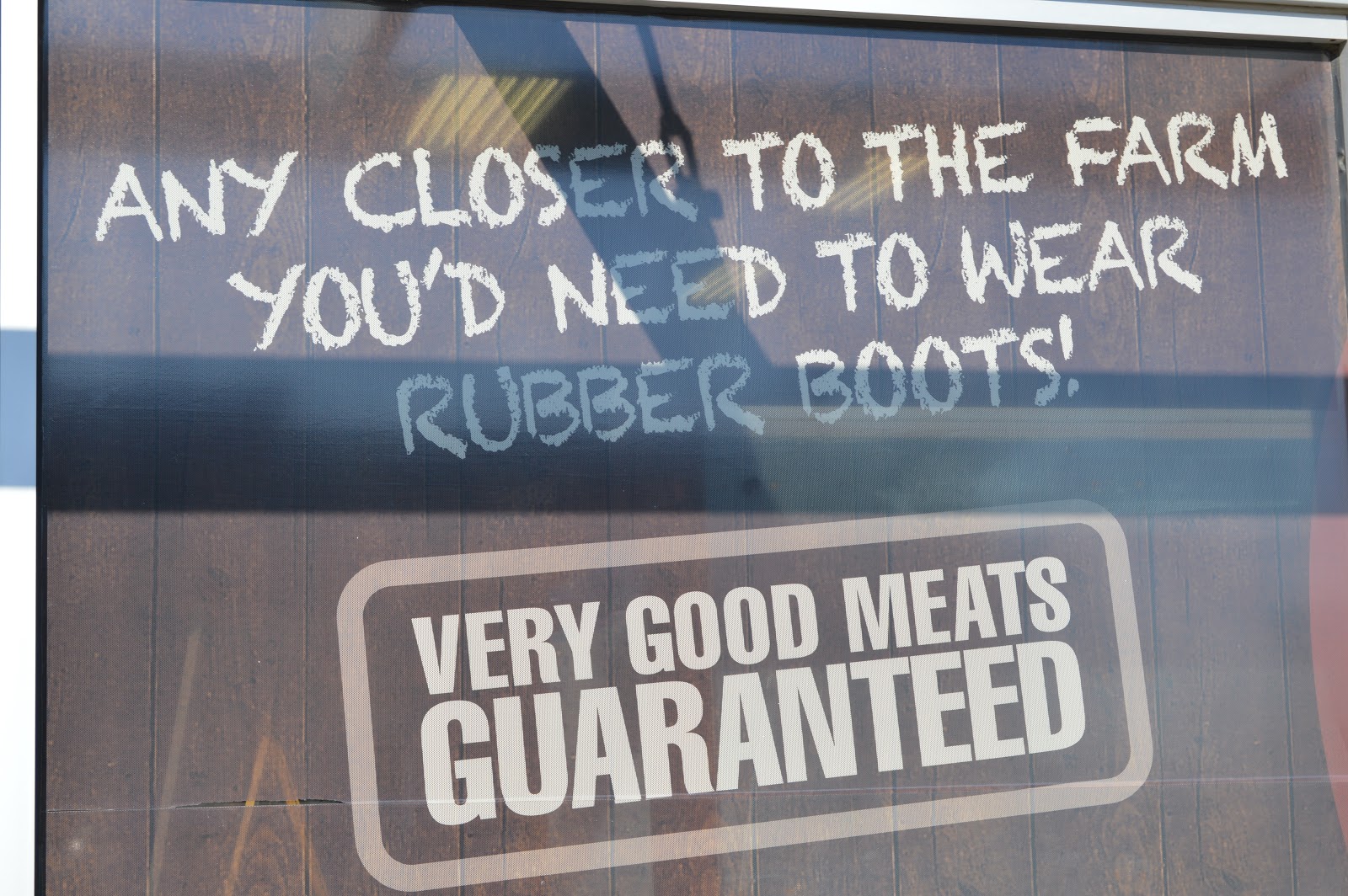
After this we boarded to coach and headed down to VG Meats at Simco.  This was a very interested business taking cattle from their farm and taking them through the processing system themselves to the customer.  It is a family run business with all the brother being involved.  The cattle are mainly Angus crosses, calving in May.  The theory of the business is quality, it's not low cost at all, but it seems to work.  The meat is taste tested with the best tasting carcases being sold to high end restaurants in Toronto.  The counter cut meat is hung for 21 days, but there is a maturing cabinet in the shop where customers can custom age their own meat, there was some in the hanging for up to 90 days!
The business is split 50:50 between retail and wholesale beef, with some lamb, pork and poultry in the shop as well, although the quantity of these is very small.  No hormones are used in this beef as it affects the eating quality, making it less tender.  It was a very interesting system, being fully integrated from the cattle feed lots right through to the end user.
After lunch the group split, heading in two directions to tow different winery's.  We headed out to Megalomanic wines on the Niagara Peninsular.  there we were met buy the very inspirational Sue-Ann Staff, who acts as a consultant and the main wine maker.  Sue-Ann, a fifth generation wine maker and Ontario's wine maker of the year in 2002, she also has her own winery Staff Wines  The passion that Sue-Ann had for the subject was incredible.  It was a lovely afternoon so we headed out to look at some vines being pruned.
The scenery was warm and stunning with lines of vines criss-crossing the fields. The area has a unique climate caused by lake Ontario keeping the very cold weather at bay, (still gets to -20 degrees C) but critically not much colder so the vines can survive.  In fact there is a new wine launched a few years ago called 'Ice Wine' that is created from grapes that are harvested when frozen.  People are employed to harvest the frozen bunches of grapes, in temperatures as low as -10! Grape vines yield anywhere between 1.5t/ha - 4t/ha and you need about 2x2m of leaf to create 1kg of grapes.  The story continued underground, a great way to avoid all the planning issues (- note to self), where the fermentation and creation takes place.
We tasted three wines, just a little taster, which was a really great fun.  I learnt how to hold the glass (by the stem) then swirl the wine in the glass before inhaling the aroma.  Then take a mouthful, not too little (good news) and swash around the mouth exposing the sensors on the tongue to the very unique flavours, then swallow!
It really was a great visit, very well hosted.  What was inspiring was the passion, knowledge and drive that Sue-Ann has for the subject, it is something that the whole group was very impressed with.  We loaded up and headed to the honeymoon capital of the world - Niagara Falls


Monday, 18 March 2013

Nuffield Contemporary Scholars Conference - Wednesday, Speaking Up For Agriculture

I was really looking forward to getting stuck into day 3 of the conference, a day entitled 'Speaking up for Agriculture'  Kelly Daynard works for an organisation called Food and Farm Care who are the voice of Agriculture sector bodies in the province of Ontario.  The organisation's role is to promote credible truthful, factual and real stories about the family farms of Ontario and to tell these stories to the customers who buy that food.  We heard how farmers are among the most respected in the community, after emergency service staff and veterinarians.  We heard how Kelly and the team are training farmers, old and young, ranchers and crop farmers, rural and more urban, to be willing and available to promote the industry.  This is about training them to speak to the media, go on television and write letters to the newspapers promoting their food and farming stories.  This training is moving out across Canada to British Columbia and Prince Edwards Island.  Food and Farm Care is also looking at other initiatives to engage with the public through Virtual Farm Tours , Faces of Farming Calendar and Lets Talk Farm Animals If 50 farmers took 10 minutes a day for 5 days of the week that would equate to a full time employee doing marketing for the industry.  Image what could be achieved in the UK or globally?
After Karen was Bern Tobin who was giving us media training.  What was the message we wanted to get across, how would we achieve that and did we need to bring in help form other people?  Bern told us to try and stick on message all times, to keep our game-face on throughout the interview and to be clear thinking and use language that could be understood by everyone.  He quoted Denzil Washington "explain it to me like I am a 7 year old" which is so very true and a comment I will remember and try and stick to. After Bern was Andrew Campbell who gave us an insight into Social Media.
I knew social media was big but I hadn't realised just how big!  Facebook (or FaceTube - #Nuffield13 joke) has 1 billion active users and twitter has 500 million users.  People are hungry for this method of engagement and short sharp communication!  We were warned though, information on the Internet is like toothpaste, once it's out of the tube it won't go back in!  I think I will be starting to use Instagram next so watch out for updates coming your way.
Agriculture More Than Ever is an industry cause to improve perceptions and create positive dialogue about Canadian agriculture.  George Klosler from Farm Credit Canada gave a great presentation about this organisation and how it is trying to raise the awareness of our great industry.  There are some really great video clips on their website showing the wonderful stories of how are food is raised or grown and by whom.  A huge thanks to FCC for sponsoring our shirts for the Nuffield group to proudly wear on our trip and he's Tafi Manjala from New Zealand very proudly displaying his new shirt! 
Len Kahn was next up, to tell us all about marketing ourselves.  We are the brand, how do we stand out in a very noisy world and how do we get our message across.  It was a great lesson all about PPEAS, Preparation, Practice, Eye contact, Appearance and Smile.
Last but by no means least we had a trio of local business people all at the top of their respective games from different farming sectors.  First up was Jackie Frasier (Middle) who runs Fraberts Fresh Food her message to me was be part of the community and focus on quality, quality quality.  There also needs to be a strong brand and there needs to be trust!
On the left (above) is Bruce Vandenburg, who owns Mariposa Dairy a company making goats cheese. The company has grown very quickly in the last 5 years with the help of one of the international supermarkets.  On the left we heard form Jason Verkaik who runs a 250 acres vegetable farm (Carron Farms) on the Holland Marsh.  Jason runs a fantastic business on rich soils growing many different vegetables including ones demanded by the growing the niche populations near Toronto, including East Indian Red Carrots.  Jason also started a harvest box scheme, as well as growing a wide range of crops from legumes to leafy greens, strawberries to gourds.
It was another long day and the last one in Guelph, so after dinner at the Borealis Grille it was time to explore The Ranch (Country and Western) bar, inhabited by a single Canadian and us.  After a hybrid Irish and Scottish country dancing, the staff very kindly started up the bucking bronco and we all had a go at staying on board!

Wednesday, 13 March 2013

Nuffield Contemporary Scholars Conference - Tuesday

Tuesday morning was an early start in the meeting hall for an introduction into the bio products industry from some very innovative and positive people.  Innovation is a message I am starting to hear loud and clear! First on the scene with a very positive opening you tube clip 'So God Made a Farmer' was Dr Gord Surgeoner who quoted to us that most people don't change because they see the light, rather they change because they feel the heat'  He also said that there is no such thing as waste, something we'll touch on later. Two other speakers followed, Hamdy Khalil who has a very interesting business making car parts out of soybean oil derivatives, such as door panels, head rests and many others.  Following up and last on before we boarded a couple of coaches to head out and explore was Dr Amar Mohanty.  We learnt about the different generations of biofuels about how ethanol is used replacing petroleum products.  We also heard about economic, environmental and social sustainability, which as a LEAF demonstration farmer I was glad to hear and many messages were the same.
We were welcomed fabulously at the Hensall District Co-op early afternoon.  The co-op was founded in 1937 and currently has over 4,200 farmer members.  The main part of the business is GM free IP (Identity Preserved) soybean storage, cleaning and packing.  IN total they would deal with over 100,000T of IP soybeans a year with most of that being exported to Asia.  Beans are sourced from all over the Ontario area but also Quebec, Saskatchewan, North Dakota and Minnesota.  Sourcing GM free beans is becoming increasingly hard to achieve, especially from the US as well over 95% of bean grown now are GM and from Canada that figure is slightly lower at 83%.  In addition to soybeans they also deal with navy beans, kidney beans, kin to beans, and small red beans, to name a few.  About 50% of the beans used in the UK for baked beans will be handled by this co-op!
The scale was very impressive, two 200T driers capable of dealing some very impressive tonnages taking moisture out of corn from 25% down to 15% for storage .  There was even a rail link to the site for deliveries of fertiliser and fuel, tow other aspects of the Co-op's business. Other aspects involved included a crop walking service with 15 fieldsmen and a contracting service offering spraying and fertiliser applications.  An alarming fact we also heard was that 75% of Canadian farmers plan to retire in the next 5 years!
We met Greg briefly who was tipping a load of beans at the site.  The lorry was very impressive, carrying upwards of 42T of produce.  there did seem to be a lot of activity around all the time we were there.  Most of the beans are exported in bags up to 2 T in weight in 20' containers.  These are trucked to Toronto before being loaded onto trains and sent to Vancouver or Montreal or Halifax depending on their destination.
Here are the New Zealand team, Steve, Lisa, Sophie, Natasha and Tafi, looking suitably cold!  It was an interesting experience for some of the Australian guys who had never actually seen snow before.
After the co-op visit we boarded the bus and headed down the road to meet Don Nott who has been growing switchgrass to use as agricultural fibre.  the grass is mowed down in the autumn and left in the swath, on the stubble to release impurities over the winter before being baled up in the spring.  Don has tried a few different methods of getting this operation correct and he thinks it's sorted now.  The fibre produced is being used to make a chip board type material that is very strong and light.
Dinner was served in the Amish Mennonite community at Anna Mae's cafe which was a very different experience.  Driving around seeing horse and buggies being used for transport.
Not like this guy, John Hodgson who has stopped off for some supper with a load of hogs in the trailer!
After a very homely dinner of carrots, potatoes, corn, beef and turkey, followed by some tremendous lemon meringue pie and then cherry pie and then pecan pie, it was off back to our hotel.  A great day and so nice to be out in the fresh air!

Nuffield Contemporary Scholars Conference - Monday

Monday morning came around very quickly and it was straight down to business with a great line up of speakers to give us an overview of the International, National and then Provincial activities. First up was:
Bob Seguin from the George Morris Centre.  Bob gave us some fantastic stats about Canada's vast land area and what is produced, exported and where the competition is coming from.  He also mentioned that farm gate incomes have risen significantly in the last few years and food and beverage sales doubled between 1991 and 2011.
Mike Toombs, Director, Research and Innovation Branch, Ontario Ministry of Agriculture, Food and Rural Affairs was next on the stage.  Mike talked about the increasing returns, costs and produce coming form the province.  71% of sales are coming form farms with individual sales of over $1 million  (17% of farms), the old 80:20 rule!
Barry Senft the CEO of Grain Farmers of Ontario followed and explained the GFO history and how they look after 28,000 members, covering 5 million acres of land and have $2.5 Billion worth of farm gate receipts.  Wheat yields here continue to increase, although from a lower starting point than in the UK.  Average yields would only be 3T/Ha.  The province is also well situated with lots of mills and elevator locations being this close to many customers, mainly in the United States. Canada is also the 4th or 5th highest wheat exporter in the world.
Bill Emmott, Chair of Dairy Farmers of Ontario (above) spoke well about the dairy industry.  I particularly enjoyed the analogy about you business and I guess life being like driving a car.  Your future is the windscreen, look forward it's big!  Your history is the rear view mirror, much smaller but useful to see where you have come from, and keeping your hands on the steering wheel gives you direction.  Also Bill talked about Farm Food Day.  This is a date in the calendar by which the average Canadian citizen would have earned enough money to pay for the years supply of food.  For Canada that day is the 14th February and for the UK its the 9th February.  The next step is to work out the date when the farm gate price is reached?
Steve Peters, the Executive Director, Association of Food Processors of Ontario was last on before lunch. This was interesting; looking at the research that is being done into new crops for new inhabitant's of the province, all with different tastes.  the attitude of 'we can grow that' seemed to make a lot of sense.
After lunch we had a trio of speakers:
David McInnes (President and CEO, Canadian Agri-food Policy Institute)
Al Mussell (Senior Research Associate, George Morris Centre (US Farm Policy)
Sterling Liddell from Rabo Agri Finance. (World economics, supply and demand, and risk awareness)
Stephen Yarrow who is the Vice President of Crop Life, Canada spoke to us about the Genetic Modification debate and what science is coming along next.  Croplife is based in Ottawa and is funded by the major plant breeding companies to try and get the scientific facts out into the debate.  We debated the sorry state we find ourselves in within the UK not being able to use this technology.  Used correctly it will be a massive benefit to our industry and environment.  The loss of investment, skills and innovation being lost form the EU will come back to haunt us!
Diana Stapleton was next on to talk about Food Banks of Canada.  It was a real eye opener.  93,000 people use food banks every month and nearly 1 in 5 of these people are employed or recently unemployed and a staggering 38% are children!  It was also good to hear that Canadian farmers are trying to help with donations of produce after farmers markets or leaving some crop unharvested that can be collected.
Terry Daynard was our final speaker of the day.  Terry spoke about sustainable farming systems, about meeting the needs of today without compromising tomorrow, an analogy I like.
Our after dinner speaker was Ken Knox who I have to say was very thought provoking and held the audience in the palm of his hand as he went through the talk.  'If I were your age, I'd do it all differently' 

Nuffield Contemporary Scholars Conference - Guelph


Well where do I start, I think I have heard that before somewhere on this trip already.  I will try and summarise what we have been doing for the last few days in Canada.  I arrived on my own having flown Air Canada instead of BA and eventually met up with the rest of the UK scholars at Toronto airport.  We loaded up and headed for the Delta hotel in Guelph where we were met by the Nuffield Canada team!  We were all kitted out in the hockey shirts, checked into the hotel, met our room mates and headed for the local hockey rink.  I am sharing a room with Jason Size who is a stone fruit farmer from Bookpurnong in South Australia.  Jason is studying the flavours and customer preferences for stone fruit.
Whilst at the hockey match a few of us took part in a burger making competition, the only thing was, we were the buns.  I teamed up with Andrew Janaway from the UK, and our Southern hemisphere competitors were Trent De Paoli (Australia) and Natasha King (New Zealand).  The object was to build the full burger with foam cheese, salad, burger and pickles out on the ice, trying to run backward and forwards delivering the ingredients.  The finale was the dive onto the burger by the top of the bun (me).  It was resounding win for the Northern Hemisphere, positive vibes for the Lions later this year?
We had a great night out and continued to make new friends late into the night.  The following morning it was presentation time.  We all had 2 minutes to introduce ourselves, our family and our study topic.  In the afternoon we took part in a scavenger hunt around the University of Guelph, taking photographs and solving puzzles.  We boarded the school bus that evening and headed to the Guelph Curling Club.
The curling was great fun.  We had some assistance from the members of the club who came to teach us the very skillful art of the gliding stones!  A big thanks to Clayton Robins and Blake Vince for their help and enthusiasm for the 60 or so curling novices setting foot onto the ice!  I was amazed at how effective the frantic brushing can make to the speed of the granite stones and ow little power was needed to send the stone on its way.
We were also treated to a lovely meal at the Curling Club before heading back to the hotel and getting ready for the start of the main event on Monday.  I took the role of Daily Lead for the Monday session so I had to organise people to introduce and thank our speakers.